Tools · 8 min read
Brand consistency: what stays fixed, what flexes, what is free
Brand consistency means customers recognize you on any shelf, screen or parcel because a few things never change: name, mark, core colors, typefaces and voice. Everything else may adapt to its channel. The work is deciding in writing which parts are fixed, which flex within limits and which are free, then watching the handoffs where drift starts.
By the Brandtune studio · Last reviewed 23 Nov 2026
In short
- Consistency is recognition, not sameness: a short list of parts never changes.
- Sort every element into fixed, flexible or free, and write down the limits.
- Drift starts at handoffs. Log the cause and fix the source, not the piece.
The short answer
Brand consistency lets a customer recognize your brand before reading the name: on a shelf, in a search result, on a parcel. It does not come from making every piece identical. It comes from a short, written list of parts that never change, clear limits for the parts that adapt, and freedom for everything else.
What does brand consistency actually mean?
It means the same brand shows up every time, even when the format changes completely. A favicon and a delivery van cannot look the same, but both can carry the same mark, the same main color and the same way of speaking.
Most advice stops at "use your logo and colors everywhere". True, but the hard questions are about everything else: can a holiday post use a fifth color, can a new label move the logo? Consistency is those answers, decided before someone has to guess.
The parts themselves are described in our guide to what brand identity is made of. This page is about keeping them steady once they exist.
Why do brands drift?
Brands rarely drift because someone ignores the rules. They drift at handoffs, when a piece of work passes to a person or a tool that does not have the original files or the reasoning behind them. These five handoffs cause most of it in consumer and online brands:
A new person. A freelancer or new hire works from a screenshot because nobody sent the files.
A new platform. A marketplace, an email tool or a store theme imposes its own layout, fonts or button style.
A rushed launch. A new product or flavor goes out with artwork adapted from the last one instead of the master.
A seasonal exception. A holiday color or campaign line is never removed and quietly becomes part of the brand.
A rewrite. Product descriptions, support replies and social captions are written by different people with no shared voice page.
How do you decide what can change? The Fixed, Flexible, Free method
Sort every element of the brand into one of three tiers, and write the tier into your guidelines next to the element.
Fixed. Never changes without a formal update to the guidelines. Customers would notice if it moved. Keep this list short, usually five to eight items, or nobody will respect it.
Flexible. Changes within named limits. The limit is the rule: "any of the four palette colors may lead a pack, never two at once" is a flexible rule; "use color creatively" is not.
Free. Left to the judgment of whoever is making the piece. Naming what is free stops people asking permission for things that do not affect recognition.
When you are unsure, ask three questions about the element. Would a regular customer notice if it changed? Does it appear on more than two channels? Is it hard to recreate from memory? Two yeses and it is fixed. One yes and it is flexible. None and it is free.
Which elements belong in each tier?
The table shows where elements usually land for a consumer brand that sells on a shelf, through its own store or both. Treat it as a starting point: a brand whose signature is a pattern will move that pattern up to fixed, and a brand that changes its photography each season may move photography down to free.
| Element | Usual tier | The limit to write down | Where drift usually starts |
|---|---|---|---|
| Name and product naming pattern | Fixed | Spelling, capitalization and how ranges are named | Marketplace listings, rewrites |
| Primary logo and symbol | Fixed | Which versions exist and the smallest size for each | Screenshots sent to freelancers |
| Core colors | Fixed | Exact values for screen and print, and which may carry text | Store themes, printers |
| Typefaces | Fixed | Which faces and weights, and the fallback on platforms that cannot load them | Email tools, marketplaces |
| Voice | Fixed | Three or four traits with a line you would and would not write | Support replies, captions |
| Signature element (pattern, wreath, italic word) | Fixed or flexible | Where it appears and how often | Rushed launches |
| Color leading on a pack or page | Flexible | Which colors may lead, and never two at once | New products, seasonal ranges |
| Photography | Flexible | Light, surface, framing and crop ratios | New photographers, user content |
| Layout of store pages | Flexible | Button style, headline length, spacing | Theme updates, new apps |
| Social post layouts | Free | Only the fixed parts apply | Rarely a problem |
| Seasonal and campaign graphics | Free, with an end date | Remove when the campaign ends | Exceptions that never leave |
Worksheet: sort your own brand
Copy these lines into a document, one block per element. Fill them in with the person who approves design work, not alone.
Element ______ · Tier (fixed / flexible / free) ______ · The limit, in one sentence ______ · Where the original file lives ______ · Who approves a change ______ · Where the rule is written ______
Start with the table, then add what is specific to your brand, such as a recurring illustration or a sign-off line. When you are done, count the fixed rows. If there are more than ten, look again: some are probably flexible with a limit you have not written yet.
The files for every fixed element belong in your brand kit, so nobody has an excuse to rebuild them. The rules belong in your guidelines; if those are not written, a brand guidelines template gives you the sections.
What does a sorted brand look like? A hypothetical example
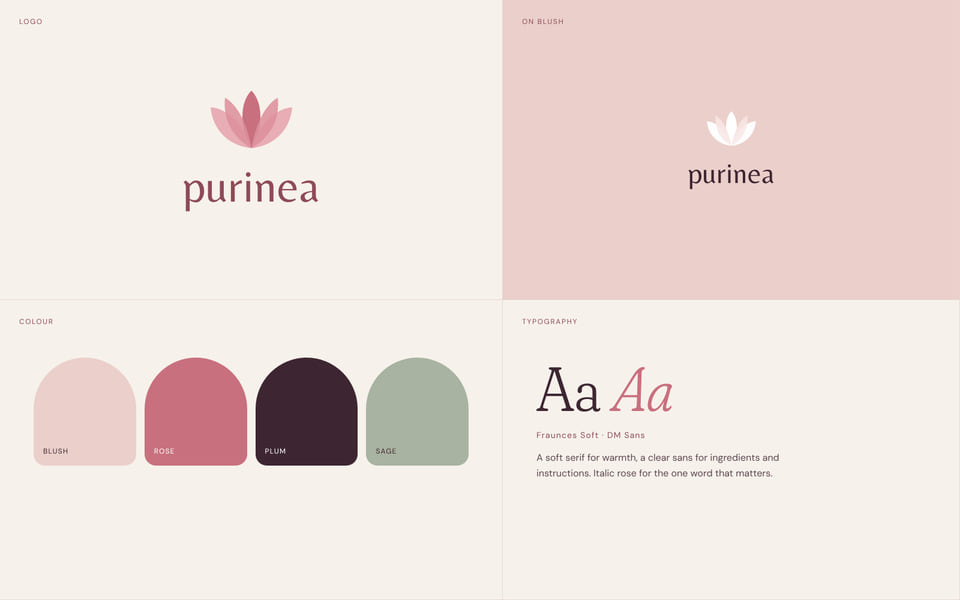
Purinea is a studio concept: a gentle skincare line for sensitive skin, sold online and in pharmacies. Its identity is a five-petal lotus, a lowercase serif wordmark, a palette of blush, rose, plum and sage, Fraunces Soft for warmth and DM Sans for ingredients and instructions, with a rose italic kept for the one word that matters. The sort below is a hypothetical example, not a record of a real project.
Fixed: the lotus and wordmark, the four colors, the two typefaces, the rose italic used once per piece, the calm and clear voice.
Flexible: which of the four colors leads on each product, within the rule that the lotus always sits on cream or blush; photo settings, as long as the light stays soft and the surface natural; headline length on the store, within one line on a phone.
Free: social post layouts, props in lifestyle photos, the order of products in a seasonal email.
Written as "fixed, once per piece", the rose italic stops being a detail and becomes what ties the pharmacy shelf, the bag and the store home page together.
How do you check for drift without a full audit?
Once a month, put the last ten published pieces side by side on one screen: a mix of store pages, emails, posts and any new packaging. Check only the fixed tier. You are not judging taste, only whether each fixed element is present and unchanged.
Every miss goes in a drift log, one line each:
Date ______ · Piece ______ · Fixed element affected ______ · Handoff that caused it (person, platform, launch, season, rewrite) ______ · Fix ______
The log is more useful than the fixes. If the same cause appears three times, the problem is upstream: the files are missing from the kit, the rule is unclear, or a platform needs its settings changed. Fix that source and the pieces stop drifting.
The side-by-side test covers recognition. When you need to know whether the brand as a whole still fits the business, run a full brand audit instead; it scores the name, identity, voice and online experience, not just the fixed parts.
When is inconsistency a sign of something bigger?
When the fixed list will not settle. If the team cannot agree which of two logos is the real one, or two greens both have defenders, that is not a policing problem. It is a decision that was never made, and no checklist can make it for you.
Small gaps can be closed by writing the missing rules, on your own or by having brand guidelines written with the studio. If the brand has outgrown its identity, the guide to whether to refresh or rebuild helps you decide how far to go.
Frequently asked questions
What is brand consistency?
Brand consistency is presenting the same recognizable brand everywhere a customer meets it: the same name, mark, core colors, typefaces and voice. The format can change by channel; those core parts do not.
Does brand consistency mean everything has to look the same?
No. A short list of parts stays fixed and the rest adapts to each channel within written limits. Forcing everything to match usually makes pieces worse at their job and gets ignored.
What is the Fixed, Flexible, Free method?
A way of sorting every brand element into three tiers: fixed parts never change without a guidelines update, flexible parts change within a named limit, and free parts are left to whoever makes the piece. It turns vague rules into decisions people can follow.
How many elements should be fixed?
Usually five to eight. If the fixed list grows past ten, some items probably need a flexible rule with a clear limit instead.
How do you keep brand consistency across a team and freelancers?
Give everyone the same files through one brand kit link, write the tier and limit for each element in the guidelines, and name one person who approves changes. Most drift starts when someone works without the original files.
How often should you check brand consistency?
A monthly side-by-side check of recent pieces catches drift early. A full brand audit is worth doing when the business changes direction or the brand starts to feel out of step.
What is the difference between brand consistency and a brand audit?
Consistency checks ask whether the fixed parts appear unchanged everywhere. A brand audit asks whether the brand as a whole still works for the business, including the name, voice and online experience.