Tools · 8 min read
Brand voice guidelines: set four dials, then test every line
Brand voice is how a brand sounds in everything it writes or says, kept recognizably the same. Brand voice guidelines make it usable: a position on four axes, a list of what the brand says and never says, and a quick test for any new line. Tone shifts with the moment; the voice does not.
By the Brandtune studio · Last reviewed 23 Nov 2026
In short
- Voice is fixed; tone moves one step at most, depending on the moment.
- Place the brand on four axes and write a line at each position.
- Run every new line through five sentences before it goes live.
The short answer
A brand voice is the character a reader hears in the words: how warm, how direct, how playful and how technical the brand sounds. Brand voice guidelines turn that character into positions a writer can hit, show examples of lines that fit and lines that do not, and give a test for checking new copy before it is published.
What is the difference between brand voice and tone?
Voice is who is speaking, and it stays the same everywhere. Tone is how that same speaker adjusts to the moment: lighter on a launch page, plainer when an order is late.
The practical rule we use is that tone may move one step along an axis, never across it. A warm, informal brand can become more careful in a delivery-delay email. It should not suddenly sound like a bank. When a team says the brand has different voices on social and in email, it usually means nobody wrote down how far tone is allowed to move.
Which four axes describe a brand voice?
Four pairs cover most of what makes two brands sound different. Each is a scale from 1 to 5, and each controls something you can see in a sentence.
Warm to formal. Contractions, “you” and “we”, how the brand greets and signs off. Position 1 talks like a friend at the counter; position 5 writes like a letter.
Direct to elaborate. Sentence length and how quickly the point arrives. At 1 the first three words carry the message; at 5 the brand sets the scene first.
Playful to serious. Whether jokes, wordplay and exclamation marks are allowed, and where. Playful does not mean silly; it means the brand is allowed to enjoy itself.
Plain to expert. Everyday words or the vocabulary of the trade. A skincare brand can sit at 3 here: it names ingredients but explains them in the same sentence.
The template: fill in your four dials
Copy the fields below into the purpose-and-voice section of your guidelines. Fill them in with real lines from your own store, not invented slogans; if you cannot find a real line at your chosen position, the position is an aspiration, and that is worth knowing.
Who is speaking. We sound like ______ talking to ______ about ______.
Warm to formal. Position (1 to 5): ______ · Why, in one sentence: ______ · A real line at this position: ______ · Too warm sounds like: ______ · Too formal sounds like: ______
Direct to elaborate. Position: ______ · Why: ______ · A real line: ______ · Too short sounds like: ______ · Too long sounds like: ______
Playful to serious. Position: ______ · Why: ______ · A real line: ______ · Where play is never allowed: ______
Plain to expert. Position: ______ · Why: ______ · Trade words we use and always explain: ______ · Trade words we never use: ______
Where tone moves. Moments where we step one notch toward formal or serious: ______ (for example a late order, a refund, a safety notice).
Five words we never write. ______, ______, ______, ______, ______.
What does a filled-in “we say, we don't say” list look like?
The table below fills in the dials for a hypothetical example: an online tea shop that sells loose-leaf tea and a monthly box. It is not a real brand and not a client. Its dials are warm 2, direct 2, playful 3 and plain 2: friendly, quick to the point, allowed a light joke, and willing to name a tea's region as long as it says what that means in the cup.
Look at how the rows behave. The product page can be playful, the out-of-stock note can smile once, and the delay email drops the joke and moves one step toward serious. The voice is still recognizably the same speaker in every row. The “we don't say” column is not wrong English; it is simply someone else talking.
| Moment | We say | We don't say | Which dial it shows |
|---|---|---|---|
| Product page headline | Smoky, sweet and very forgiving if you forget the timer. | An exquisite artisanal infusion for the discerning palate. | Plain 2, playful 3 |
| Out of stock | Sold out for now. Leave your email and we'll tell you the day it's back. | Unfortunately this item is currently unavailable. | Warm 2, direct 2 |
| Late order | Your tea is running late. It left us on time, and we're checking with the courier today. | Oops! Looks like your tea got lost on its adventure! | Tone moves one step to serious |
| Checkout error | That card didn't go through. Try again, or pick another way to pay. | Transaction failed. Error code 402. | Plain 2, warm 2 |
| Order email subject | Your tea is packed | Order confirmation #000000 – Thank you for your purchase | Direct 2 |
| Monthly box | Three teas a month, picked by us, explained on one card. | Discover a curated journey through the world of tea. | Direct 2, plain 2 |
How do you test whether a line sounds like the brand?
Read the line, then check it against five sentences. Each must be true. Five out of five ships; four means fix the one that failed; three or fewer means rewrite from the dial positions, not from the old line.
1. I could read this aloud to a customer without changing a word.
2. It sits at our position on all four axes, or one step away for a reason I can name.
3. It uses no word from our never-write list.
4. With the logo covered, a regular customer would know it is us.
5. It tells the reader one thing they need for their next step.
Run it on five lines from five places at once, such as the home page headline, a product description, an error message, an order email subject and a social caption. A voice that passes on the home page and fails on the error message is the most common pattern, because those lines are written last, by whoever is closest.
Where should brand voice guidelines live?
Inside the brand guidelines, in the first section, and again as a single page wherever copy is actually written: the store admin, the email tool, the shared folder the social editor opens. Our brand guidelines template puts purpose and voice first for that reason.
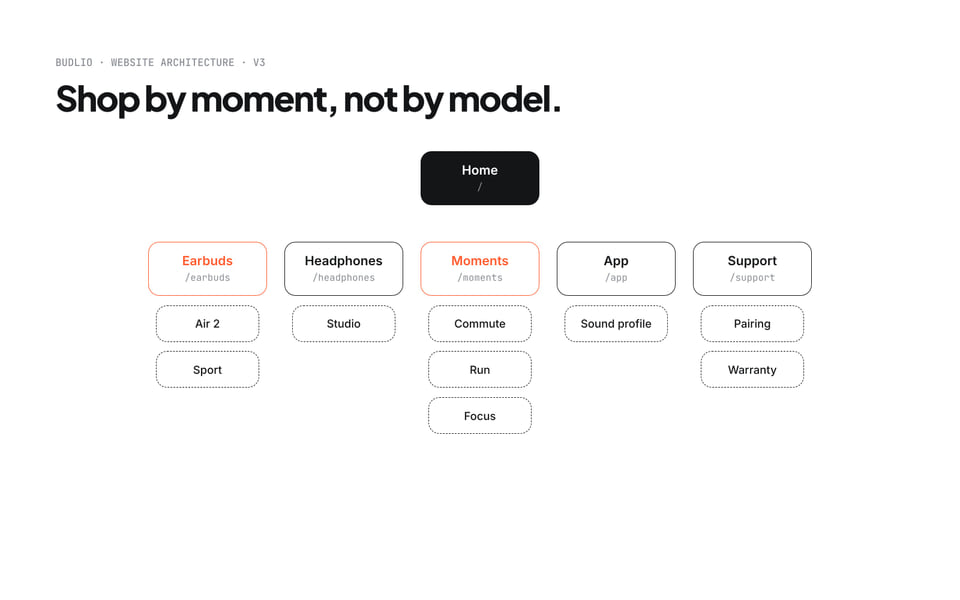
Voice is also visible in design decisions. In Purinea, a skincare studio concept, a rose italic is kept for the one word that matters, which is a voice rule set in type. In Budlio, an audio studio concept, the store is organized as “Shop by moment, not by model”: direct, plain and a little playful, written into the site map before any product copy existed. See the Budlio concept for the whole structure.
When do you need more than a voice page?
When the problem is not how the brand sounds but what it says. A voice page can make a weak claim sound friendly; it cannot make it true or relevant. If writers keep asking what to say, rather than how, the gap is the message, and a brand messaging framework comes first.
Voice also depends on the name and the identity it sits beside. A playful voice under a serious name creates friction the copy cannot fix. If you are still settling those, start with brand strategy or brand identity, and see how to name a brand if the name is still open.
Frequently asked questions
What is brand voice?
The consistent character a reader hears in a brand's words: how warm, direct, playful and technical it sounds. It stays the same across the store, emails, packaging and social posts.
What are brand voice guidelines?
The written rules that let anyone write in the brand's voice: positions on a few clear axes, examples of lines that fit and lines that do not, and a way to check new copy.
What is the difference between voice and tone?
Voice is the brand's fixed character. Tone is how that character adjusts to a moment, such as a launch or a late order, and it should move only a little.
How many voice traits should a brand have?
Few enough to remember while writing. Four axes, each with a position and an example line, are easier to apply than a long list of adjectives.
Can a brand have a different voice on social media?
It can have a slightly different tone, usually lighter, but the same voice. If the social posts would not pass the brand's test with the logo covered, they have drifted.
Who should write the brand voice guidelines?
Whoever writes or approves most of the brand's copy, with the founder or brand owner signing off the positions. The examples should come from real lines the team has written.
How do you keep a brand voice consistent with several writers?
Give every writer the one-page version, review new copy with the five-sentence test, and add good and bad real examples to the guidelines as they appear.