Tools · 9 min read
Brand messaging framework: what you say, and the proof, on one page
Brand messaging is what a brand says about itself and why anyone should believe it. A brand messaging framework fits it on one page: a positioning line, three pillars each backed by a proof a customer can check, one message per audience and a short answer to each common objection. Voice decides how it sounds.
By the Brandtune studio · Last reviewed 23 Nov 2026
In short
- One page: positioning, three pillars with proof, audiences, objections.
- A pillar without a checkable proof is a wish, not a pillar.
- Map each part to the place on the store where a buyer meets it.
The short answer
Brand messaging is the set of things a brand consistently claims. The framework is the one-page reference behind every headline, product page and email: who the brand is for, why it is different, what proves it and how it answers doubts. If it does not fit on one page, it is not decided yet.
How is a messaging framework different from voice or a tagline?
Messaging decides what is said. Voice decides how it sounds. A tagline is one short output of the messaging, the way a headline is one output of the voice.
Keep the documents separate. A framework that tries to set tone ends up full of adjectives and no claims; a voice page that tries to set messages ends up full of slogans. The brand voice guidelines handle the sound, with four dials and a test. This page handles the substance and the evidence.
What goes on the one page?
Four blocks, in this order, because each one leans on the one before.
Positioning. One sentence: who it is for, what it is and why it is different. Everything else on the page has to agree with it.
Three pillars. The three reasons to choose the brand, each with a proof a customer can see or check, and the place where they see it.
Audience messages. One line for each group of buyers, saying which pillar matters most to them and why.
Objections and answers. The doubts that stop a purchase, each with a short answer and the proof behind it.
The template: fill in the framework
Copy these fields into a single page. Write in plain sentences, not keywords; if a field needs a paragraph, the decision behind it is not made yet.
Positioning. For ______ who ______, [brand] is the ______ that ______, because ______.
Pillar 1. Claim: ______ · Proof a customer can check: ______ · Where they see it: ______
Pillar 2. Claim: ______ · Proof: ______ · Where they see it: ______
Pillar 3. Claim: ______ · Proof: ______ · Where they see it: ______
Audience A. Who: ______ · What they are trying to do: ______ · The one message: ______ · Pillar it leans on: ______
Audience B. Who: ______ · Trying to do: ______ · Message: ______ · Pillar: ______
Objection 1. They think: ______ · We answer: ______ · Proof: ______
Objection 2. They think: ______ · We answer: ______ · Proof: ______
Objection 3. They think: ______ · We answer: ______ · Proof: ______
Owner and date. ______ · ______
How do you know a pillar is strong enough?
Give it three tests: a customer can check it, it is specific to you, and it answers a real buying question. A claim that fails the first test is an aspiration and goes in a strategy note, not on the page.
Checkable. “Made with care” cannot be checked. “The full ingredient list is printed on the front of the pack” can, and a buyer sees it before reading a word of copy.
Yours. If a brand in the same aisle could say it truthfully tomorrow, it is a category fact, not a pillar. Category facts still go on the product page; they just do not lead.
Needed. It answers something buyers actually ask before they pay. Look at the questions in your support inbox and product reviews of your own store; if no one asks about it, it is probably not a pillar.
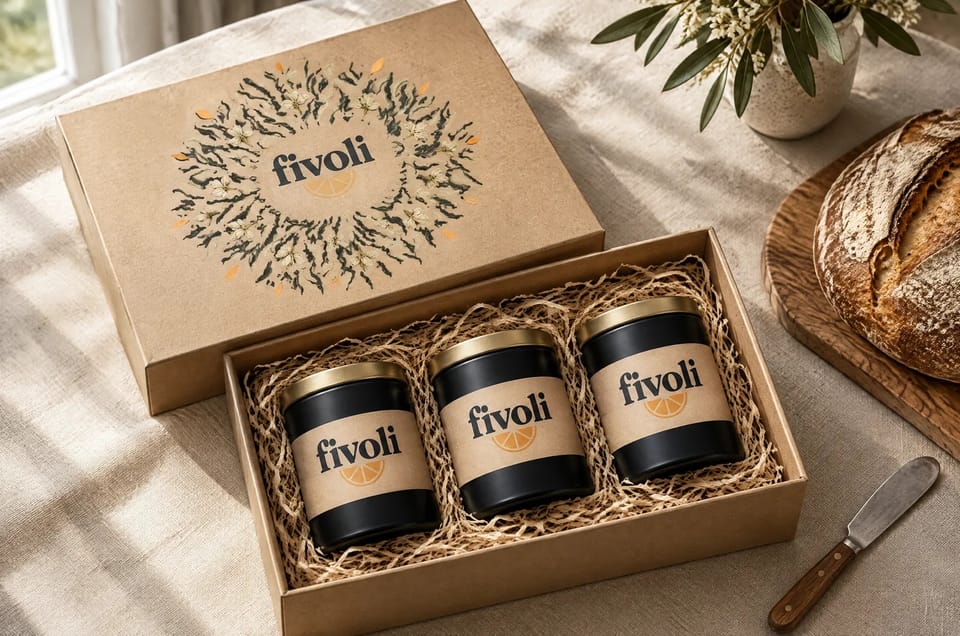
The strongest proofs are often designed rather than written. Fivoli, a studio concept, had to work as a present across many flavors. The answer is in the objects: a hand-drawn citrus wreath on every label that ties the flavors into one family, and a kraft gift box that holds three jars. The message “a pantry brand that looks like a gift on the shelf” barely needs defending, because the pack shows it.
What does a filled-in framework look like?
A hypothetical example, not a real brand or client: a hand soap sold online, shipped once in a glass bottle and then as refills by mail.
Positioning. For people who want a tidy bathroom shelf without a cupboard of empty plastic bottles, the brand is the hand soap you buy in glass once and refill by mail, because the refill pouch is made to fit a standard mailbox.
Pillar 1: the refill fits the mailbox. Proof: pouch measurements on the product page and a photo of it in a mailbox. Seen on: product page, first email.
Pillar 2: one bottle for good. Proof: the glass bottle and the pump are sold separately as spare parts. Seen on: product page, spare-parts page.
Pillar 3: scents named by what is in them. Proof: each scent is named after its main ingredient, and the full list is on the front of the pouch. Seen on: pack, product page.
Audiences. First-time buyers: “Buy the bottle once; after that it is pouches.” Gift buyers: “A glass bottle that looks good next to any sink.” Subscribers: “Your refill arrives before the bottle runs dry, and you can change the date.”
Objections. “The pouch will leak in the mail.” We answer: it is sealed and packed flat, with a photo of the pack as it arrives. “Glass will break in the bathroom.” We answer: the base is thick, and a spare bottle can be bought on its own.
Notice what is absent: no figures about plastic saved, no promise of results. Those would need sources the brand does not have yet, so the framework leaves them out rather than guessing.
Where does each part go on a store?
Every block of the framework has a natural home on an online store, and placing it deliberately is how the framework stops being a document and becomes the site. The table below is the map we use when a framework is handed to the people building the store.
Read it as a checklist after launch too. If an objection keeps arriving by email, its answer is not where the buyer looks. Move it closer to the button. Our guide to ecommerce homepage design covers the first screen in more detail.
| Framework part | Where the buyer meets it | How long it can be | Check after launch |
|---|---|---|---|
| Positioning | First screen of the home page, about page, social bio | One sentence, often shortened to a headline | Could a visitor say who it is for after one screen? |
| Pillar claims | Home page sections, top of each product page | A short line each | Does each section lead with one pillar, not three? |
| Proof | Product photos, details tab, packaging, spare-parts or ingredients pages | As long as the evidence needs | Can the buyer see it without asking? |
| Audience messages | Collection pages, landing pages, welcome emails, ads | One headline and one line | Does each audience land on its own page? |
| Objection answers | Near the add-to-cart button, cart, product FAQ, returns page | One or two sentences | Is the same question still arriving by email? |
| Tagline | Pack, footer, social header | A few words | Does it agree with the positioning line? |
When should you revise the framework?
When a proof stops being true, a new audience starts buying, or the same objection keeps coming back. Each of those changes one block, and the rest of the page usually holds.
Revise the positioning line last and rarely. If it needs changing, the brand has moved, and that is a strategy question: a brand audit or a brand strategy project should come before new copy. If you are starting from nothing, the brand discovery questionnaire gathers the answers the template asks for, and ecommerce website design is where the finished framework becomes pages.
Frequently asked questions
What is brand messaging?
What a brand consistently says about itself: who it is for, why it is different and why that is believable. It sits behind every headline, product page and email.
What is a brand messaging framework?
A one-page reference that sets out the positioning, the main claims with their proof, the message for each audience and the answers to common objections, so everyone writes from the same decisions.
What is the difference between messaging and positioning?
Positioning is the single sentence about who the brand is for and why it is different. Messaging is everything built on it: pillars, proof, audience lines and answers to doubts.
How many message pillars should a brand have?
Three is a good limit for a consumer brand. More than that and no page can lead with any of them.
What counts as proof for a brand message?
Something a customer can see or check: a product detail, a photograph, a printed ingredient list, a spare part they can buy. A claim with no proof belongs in a strategy note, not on the page.
Who uses the messaging framework?
Anyone who writes for the brand: the founder, copywriters, the store builder, whoever writes emails and ads, and customer support when answering doubts.
How often should a messaging framework be updated?
When a proof changes, a new audience appears or an objection keeps returning. The positioning line should change rarely, and only after a strategy review.