Brand strategy
Brand strategy for consumer brands, settled before the design
Brand strategy is the set of decisions a brand's design is built on: who it is for, which shelf it competes on, what makes it different and what it refuses to be. At Brandtune it is the opening phase of our identity and rebranding projects, written on one page and agreed before any logo, pack or store is drawn.
What the brand strategy project covers.
Agreed in writing before design starts, so you know what is in the project and what is not.
- Listening before deciding
Your product, how it is sold and the words customers already use in reviews and support messages, read before anyone proposes a direction.
- The shelf and the feed
A look at where a buyer will meet the brand, on a shop shelf, a marketplace page or a social feed, and at the conventions that category expects.
- The one-page positioning sheet
Six fields filled in and agreed: for whom, category, difference, proof, tone and what the brand is not.
- Strategy translated into design rules
Each decision on the sheet turned into a rule the identity has to follow, so routes can be judged against something written.
- A check on name and structure
Whether the brand needs a new name or a clearer family of lines before design starts, flagged early rather than discovered late.
How brand strategy turns into design decisions
The method we use at the start of every identity project, and the one-page sheet you can fill in yourself.
What does brand strategy mean for a brand that sells online?
For a consumer brand, strategy is a short list of choices that the pack, the store and the feed all have to obey. It answers who buys, where they compare, why they would pick you and what you will never look or sound like.
Long strategy decks often fail because nobody can design from them. A page of values that every brand in the category could sign does not tell a designer whether the label should be quiet or loud. We keep strategy to the decisions that change something visible, and leave the rest out until it is needed.
Why does strategy come before the logo?
Because a logo can only be judged against a decision. Without a written positioning, the review meeting turns into a vote on taste, and the winning route is whichever one the most senior person liked that day.
That is why strategy opens our brand identity projects and the decide step of every rebrand. If the sheet shows the name is the problem, naming comes next; if the business sells several lines, brand architecture is settled before the mark, because the structure decides what each piece has to carry.
The one-page positioning sheet
- For whom. The buyer, described by the moment they buy, not by age bracket. One sentence: ______
- Category. The shelf or the search where they will find you and compare you. One sentence: ______
- Difference. The one reason to pick you on that shelf that the others cannot also claim. One sentence: ______
- Proof. What the buyer can see or check that makes the difference believable: an ingredient, a format, a detail on the pack. One sentence: ______
- Tone. Three words for how the brand sounds, and one word it must never sound like: ______
- What we are not. Two or three directions that are tempting but wrong for this brand: ______
How do you fill in the sheet without writing something generic?
Write one sentence per field and make each one exclude something. If a line would still be true of every other brand on the shelf, it is a category description, not a positioning, and it needs another draft.
Fill in the fields in order, because each one narrows the next. The difference only means something once the category is fixed, and the proof only matters once the difference is clear. The last field is the hardest and the most useful: naming what the brand is not gives the designer permission to drop routes early instead of polishing all of them.
If you want the questions that feed each field, our brand discovery questionnaire lists them. Once the sheet is agreed, the words the brand uses grow from it in a messaging framework, and the tone field becomes the start of the voice guidelines.
What does a filled-in sheet look like?
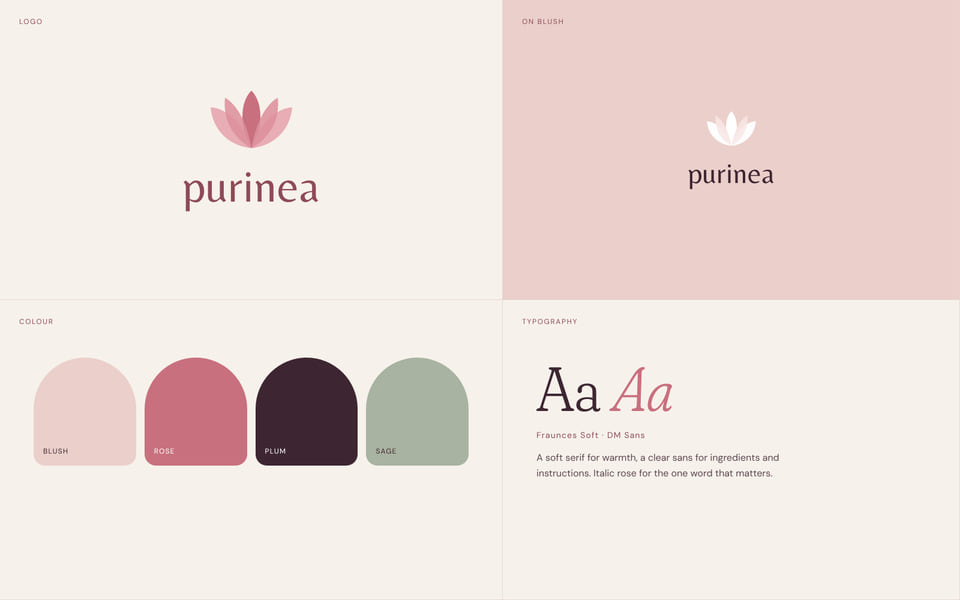
- Studio concept: Purinea, a gentle skincare line, filled in from what the concept already set out.
- For whom. People with sensitive skin who buy online and in pharmacies.
- Category. Skincare on a crowded pharmacy shelf, next to products that look clinical.
- Difference. Clinical enough to trust and soft enough to love: calm skin, in three quiet steps.
- Proof. Ingredients and instructions kept clear on every pack, in a plain sans serif. A concept has no test results, so this field stays about what the pack shows.
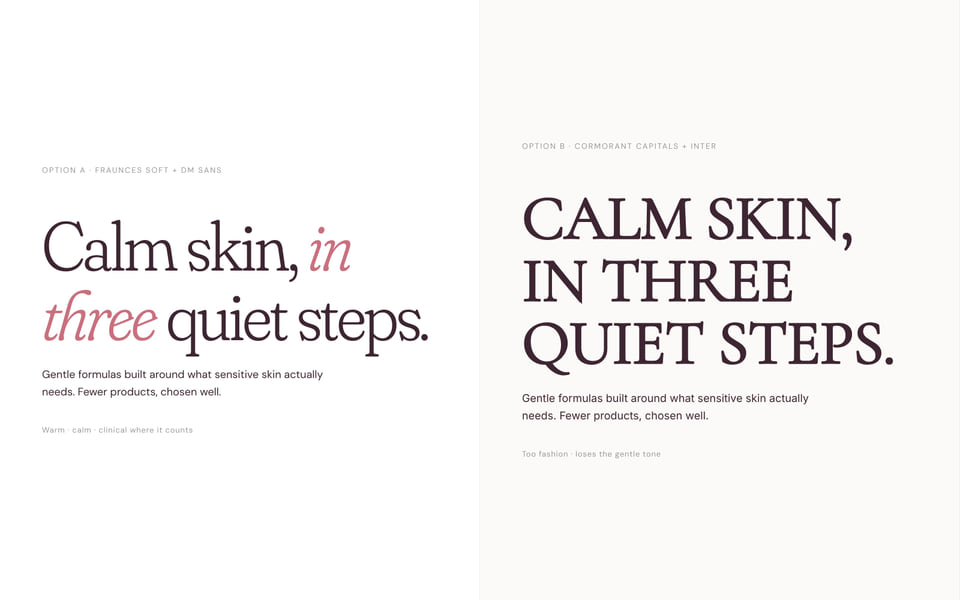
- Tone. Calm, gentle, clear. Never fashion.
- What we are not. Not a fashion label, which is why the serif capitals route was set aside.
Which strategy decision changes which design decision?
Every field on the sheet settles a specific part of the design, and the table below shows which. Read it the other way round too: when a design argument will not end, the field it depends on is usually the one left vague.
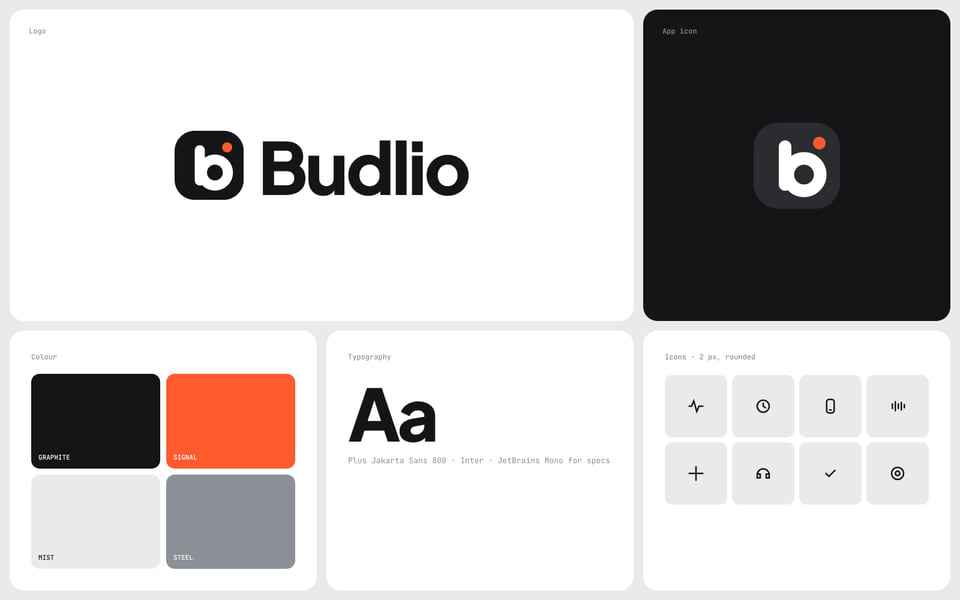
The examples are studio concepts from our Muro, Purinea, Budlio and Fivoli work, where the same pattern held: a written decision first, then routes judged against it.
| Strategy decision | Design decisions it settles | What goes wrong if it stays open | Studio concept example |
|---|---|---|---|
| For whom | Type personality, imagery, the store's first screen and its navigation | The design aims at everyone and is remembered by no one | Muro: one chocolate bar, three buyers, so three store directions (Loud, Reserved and Club) |
| Category | Which shelf codes to respect and which to break: pack format, color expectations, density of information | The brand looks out of place, or looks like everything beside it | Purinea: a pharmacy shelf asks for trust before warmth |
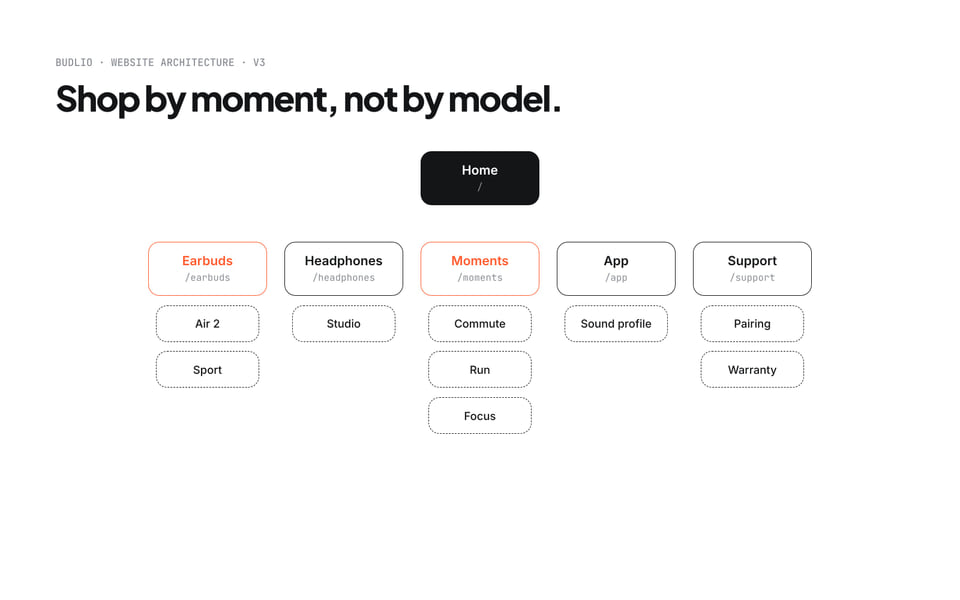
| Difference | What the identity exaggerates and how the store is organized | Every element gets equal weight and the reason to buy is lost | Budlio: shop by moment, not by model, so the store map follows the day |
| Proof | What the pack and the product page show first, and the typeface that carries the detail | Claims sit in the copy with nothing on the page to back them | Budlio: a monospaced typeface kept for specs |
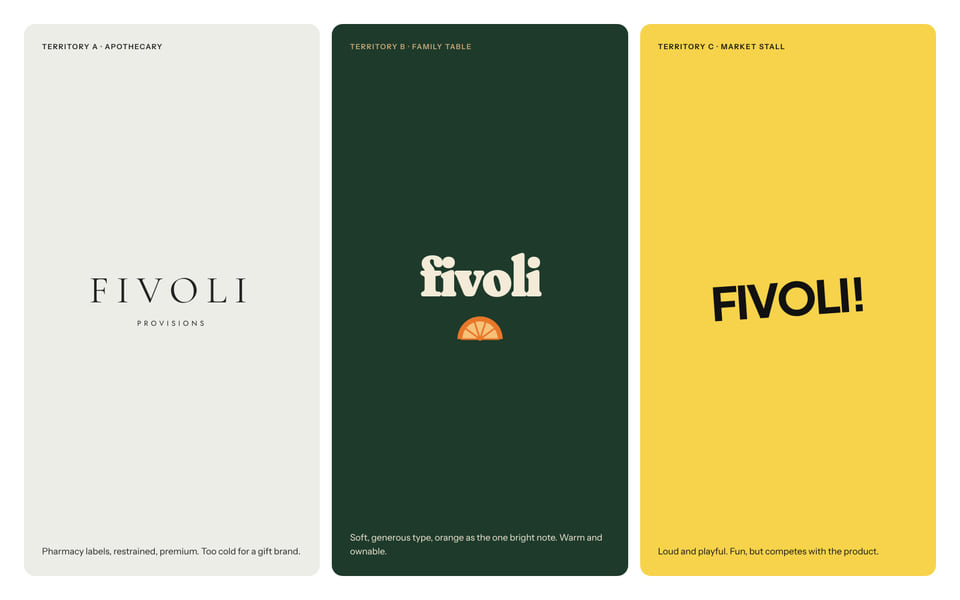
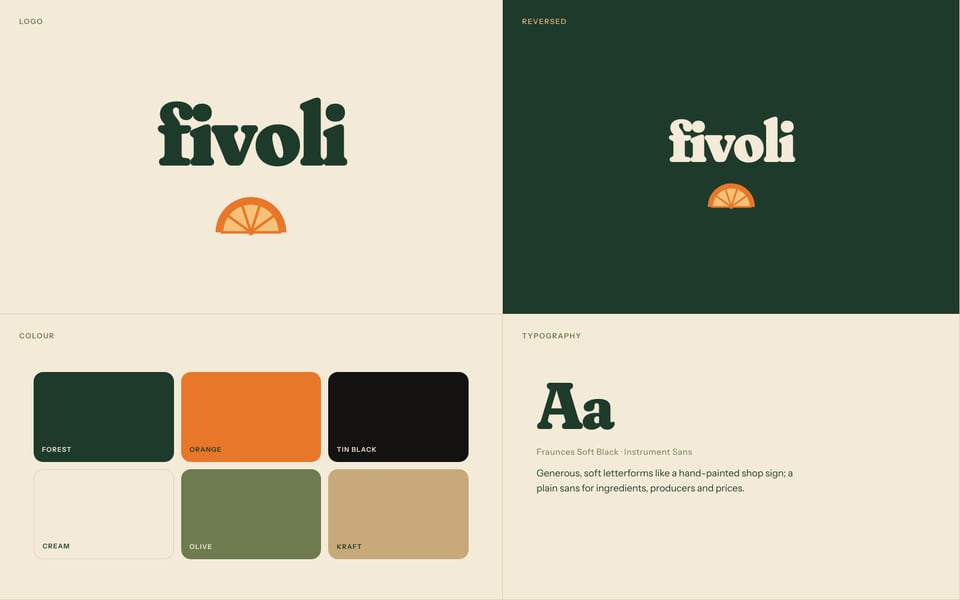
| Tone | Type weight, color temperature, the light in the photography and the words on buttons | Each piece sounds like a different company | Fivoli: family table, a generous wordmark and a hand-drawn wreath |
| What we are not | The routes that are dropped before they are shown | Weeks spent polishing directions that were never right | Fivoli: apothecary set aside as too cold for a gift; Purinea: serif capitals set aside as too fashion |
Brand positioning, brand platform, brand strategy: which one do you need?
Most brands that are about to commission an identity need the positioning and the design rules that follow from it, which is what the one-page sheet holds. A full brand platform, with purpose, values and messaging written out, earns its place when many people will speak for the brand, such as a large team or several retail partners.
Start with the page. If the brand later needs the fuller platform, it is built on the same six fields, so nothing is thrown away.
How do you know the strategy is good enough to design from?
Give the sheet to someone who has never seen the brand and ask them which of two routes fits it better. If they can answer and say why, the strategy is ready; if they shrug, a field is still too vague.
A second test: every line on the sheet should rule out at least one design move. If a line rules out nothing, rewrite it before the identity work starts, because it will be argued about later anyway, at a higher cost in time.
What you receive at the end.
What you receive at the end of the project.
- The one-page positioning sheet, filled in and agreed
- A short written review of the shelf and feed where the brand will be seen
- The design brief that the identity routes are judged against
- A list of what the brand is not, with the directions it rules out
- Any wider strategy work, such as naming or brand architecture, agreed in writing in the proposal
How the project runs.
Four steps, each with something you can approve before the next one starts. The schedule for each is written into the proposal.
Listen
Your product, your buyers and what they already say about you, in their own words.
Notes in writing, shared with you.
Look at the shelf
Where the brand will be seen and what that category usually looks and sounds like.
A short review of the shelf and feed.
Decide
The six fields of the positioning sheet, argued and agreed one by one.
The signed-off positioning sheet.
Translate
Every decision on the sheet turned into a design rule for the identity, the pack and the store.
The design brief that opens the identity work.
Decided on paper, then drawn.
In each studio concept a written decision came first, and the design was judged against it.
Related work.
Self-initiated studio concepts, each with its identity, applications and website.
Common questions
About brand strategy
What is brand strategy?
Brand strategy is the set of decisions about who a brand is for, where it competes, why someone should pick it and how it should sound. It is written down before design so the identity expresses a decision instead of making one.
What is the difference between brand strategy and brand positioning?
Positioning is the core of the strategy: the place the brand takes in a buyer's mind compared with the other options on the same shelf. The strategy adds what positioning needs to work in practice, such as tone, proof and the things the brand refuses to do.
What is a brand platform?
A brand platform is the fuller written version of the strategy, often with purpose, values, personality and messaging. The one-page sheet is the part the design depends on; a fuller platform can be added and is agreed in writing in the proposal.
Can we buy brand strategy on its own?
Strategy is the opening phase of our identity and rebranding projects. Whether it can be scoped as a separate piece of work is agreed in writing in the proposal.
We already have a strategy document. Do we start again?
No. We read it first and fill in the positioning sheet from it. The fields it leaves blank become the questions for the first conversation.
Does a small brand need a brand strategy?
Yes, but a short one. A brand with one product still has to decide who it is for and what it is not, and one page is usually enough to hold that.
Do you run customer surveys or market research?
We work from what already exists: your product, what customers write in reviews and support messages, and the shelf where the brand will be seen. Any further research is agreed in writing in the proposal.
How long does brand strategy take?
The schedule is written into the proposal before anything starts.
Also as one project
Brand identity, planned with this one.
Brand identity design gives a consumer brand a name, a mark and a visual system it can put on a pack, a shelf, a campaign and a product page without losing its voice. We build it in three layers, a base system, its applications and a living system, and you make six decisions along the way, each one in writing.
Tell us what the brand has to stand for.
A short request, a call about the product and the people who buy it, then a proposal with scope and schedule in writing.
Scope and schedule in writing before design starts.
- 01You tell us about the project in a short request.
- 02A short call to agree what the project needs.
- 03A proposal with scope and schedule in writing.