Brand naming
Naming agency for consumer brands
A naming agency for consumer and e-commerce brands. We write the brief, explore name territories and put every shortlisted name through a seven-test sheet: said aloud, spelled from memory, seen at small size and read in each market. You choose one name with its reasoning on paper, and your own legal adviser clears it.
What the brand naming project covers.
Agreed in writing before design starts, so you know what is in the project and what is not.
- Naming brief
Who will say the name, in which languages and places, what it must suggest and what it must never sound like.
- Name territories
Directions such as descriptive, evocative or invented, each with example names and the reason it could suit the brand.
- The seven-test sheet
Every shortlisted name is scored on the same seven tests, so the choice is made against the brief rather than on first impressions.
- Market read
The sheet flags each market language and asks a native speaker to read the name; we do not claim translations ourselves.
- Address and handle screening
A first look at whether a usable web address and handle pattern exists for each finalist. It is a screening, not a registration.
- How the name is written
Capitals, spacing and any accent decided once, ready for the logo and the brand guidelines.
How we test a name before you fall for it
Names are compared by kind first and then run through the same seven tests, so taste is the last filter and not the first.
Which kind of name suits your brand?
Start with the kind of name before the name itself. A descriptive name, an evocative one, an invented word, a founder's name and a compound each solve a different problem, and each fails in a predictable way. Choosing the kind first stops a team from arguing about two words that were never competing for the same job.
The table below is the one we use in the territories stage. If you want the full sequence from brief to decision, our guide on how to name a brand walks through it step by step; this page adds the testing sheet and how we apply it in a project.
| Kind of name | What it is | When it fits | What to watch | Test that matters most |
|---|---|---|---|---|
| Descriptive | Says what the product is or does. | A single clear category where customers search by what they need. | Hard to stand out and hard to stretch to a new category. | 6. Stretch |
| Evocative | A real word that suggests a feeling, a place or a quality. | Brands that sell on mood or story more than on specification. | Real words are often close to names already in use. | 7. Distance |
| Invented | A new word built from sounds or word parts. | Brands that need a name they can fill with meaning over time. | It says nothing on day one, so the identity must do more work. | 2. Spell it from hearing |
| Founder | A person's name or family name. | Brands built on a maker's craft or a family recipe. | It ties the brand to one person and can be hard to hand on. | 5. Read in every market |
| Compound | Two words or parts joined into one. | Brands that need to say two things at once, such as a product and a quality. | Joins can create unwanted words or awkward letter pairs. | 3. See it small |
The seven-test name sheet
- 1. Say it once. Read the name aloud to someone who has not seen it. Can they repeat it straight back? Result: ______
- 2. Spell it from hearing. Say it over a call and ask them to type it. Count the spellings you get. Result: ______
- 3. See it small. Set it at favicon, label and social-avatar size. Does it still read, and does any letter pair blur? Result: ______
- 4. Address and handle pattern. Is there a plausible web address and one handle pattern you could use everywhere, with or without a short modifier? A screening only. Result: ______
- 5. Read in every market. A native speaker of each market language reads it and notes any meaning, sound or association that works against the brand. Result: ______
- 6. Stretch. Put the name on the product you will sell in a few years, not only the first one. Does it still fit? Result: ______
- 7. Distance. Say it next to the names already in your category. Could a customer mix them up by ear? Result: ______
How the sheet is used in a project
Everyone on your side scores the shortlist alone before anyone talks. Then the scores are compared in one call. This keeps the loudest opinion in the room from deciding, and it shows where people disagree for real reasons.
Tests 1 and 2 weigh the most for brands sold by recommendation, on the phone or in a busy shop: a name that is misheard or misspelled from the start rarely recovers. Test 6 weighs the most for brands that plan a range. A name can fail one test and still win, but only when the brief says why that test matters less, and that reason is written next to the score.
What a screening can and cannot tell you
Tests 4 and 7 are screenings. They show whether a name is worth taking further, not whether you are free to use it. Trademark searches, registrations and any legal opinion on a name are done by your own legal professional, and we hand them a short summary of the finalists to start from.
Our role ends at a recommendation with its reasoning. That boundary keeps the decision honest: you know what was tested by the studio and what still has to be cleared before the name goes on a pack or a store.
Why we explore territories, not long lists
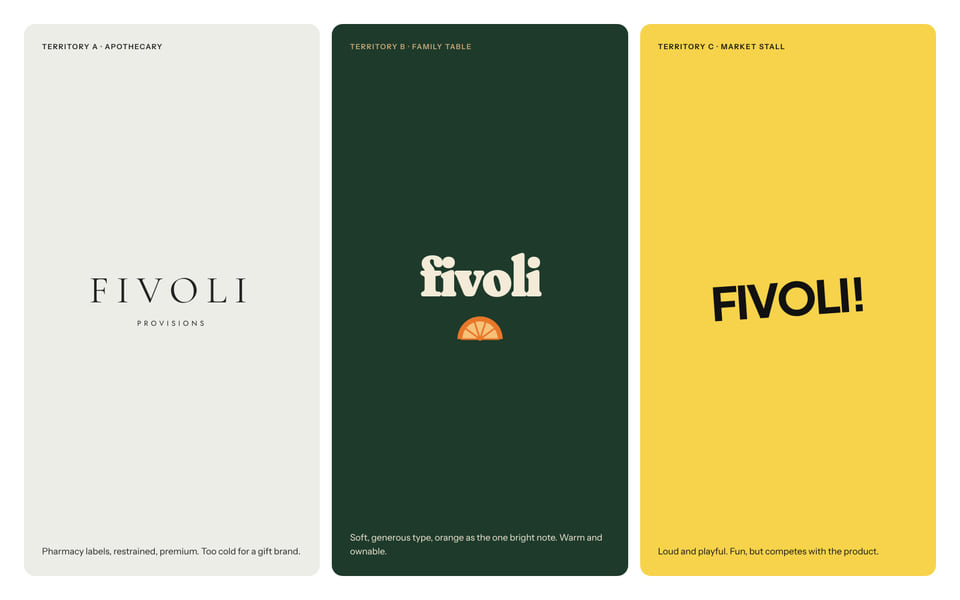
A list of two hundred names hides the real choice. Territories group names by the idea behind them, so you react to directions first and to words second. In the Fivoli studio concept, three territories were compared before one went forward, and the name was weighed inside the direction that won rather than on its own.
Each territory comes with a handful of examples and one sentence on what it would say about the brand. If none of them feels right, that is useful too: it usually means the brief needs another line, not that the studio needs another hundred names.
Where naming sits in a bigger project
A name is the first piece of an identity, so it is usually followed by the mark and the system around it in a brand identity project, and by the logo drawn around the agreed spelling.
If you are renaming a brand that already sells, the name is one decision inside a rebranding, and an audit should show that the name is really the problem. For ranges and sub-brands, the naming pattern is planned together with the brand architecture, so the tenth product is as easy to name as the first.
What you receive at the end.
What you receive at the end of the project.
- The naming brief
- Territories with example names and the reasoning behind each
- A shortlist scored on the seven-test sheet
- A recommended name and the rule for writing it
- A shortlist summary to hand to your legal adviser for clearance
How the project runs.
Four steps, each with something you can approve before the next one starts. The schedule for each is written into the proposal.
Brief
Audience, markets, tone, the range the name must cover and the words to avoid.
The naming brief.
Territories
Several kinds of name explored side by side, with examples of each.
Territories to react to.
Shortlist and tests
The strongest names run through the seven tests, by ear and by eye.
A scored shortlist with notes.
Decide
One name, how it is written and what your legal adviser needs to start.
The recommendation.
Related work.
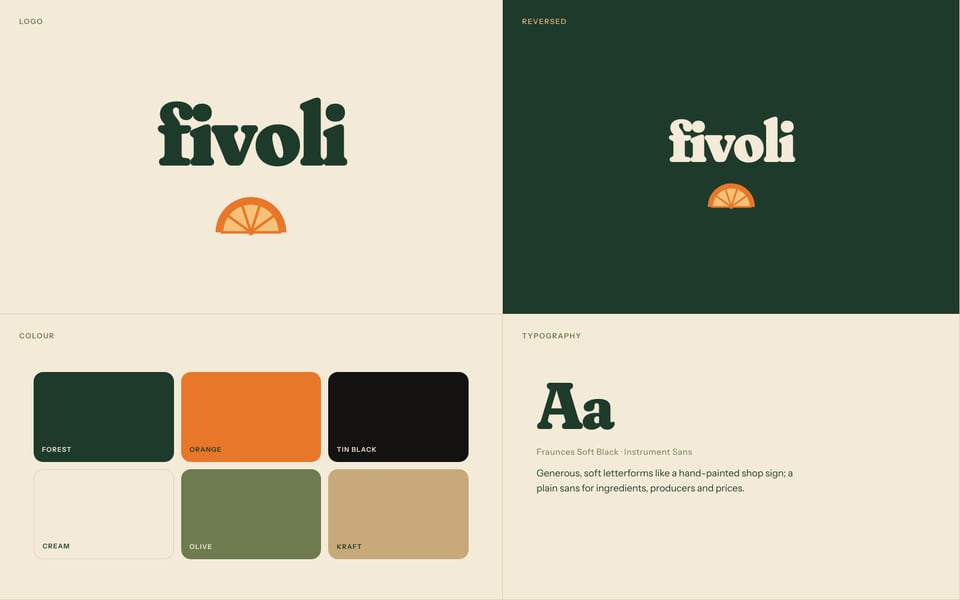
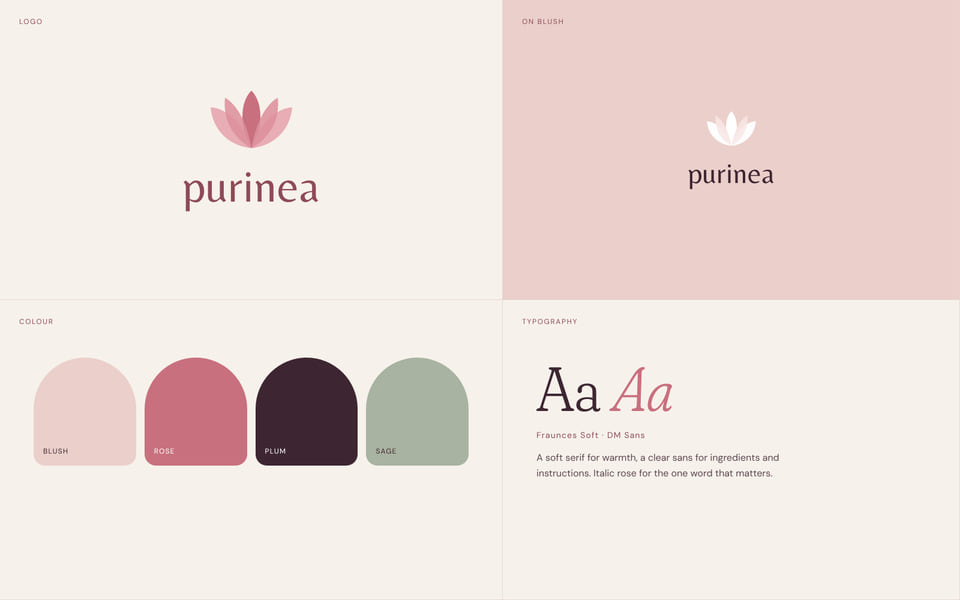
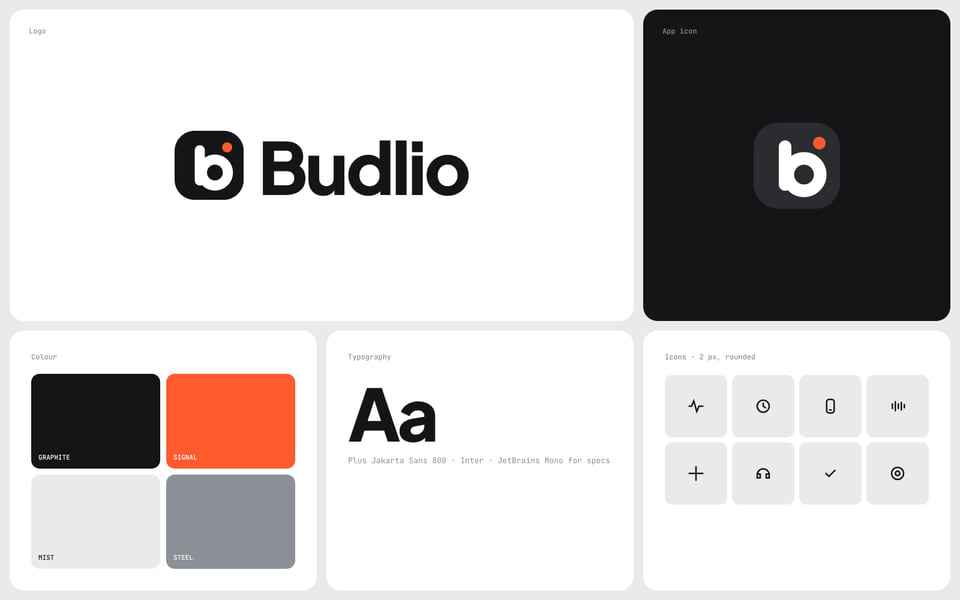
Self-initiated studio concepts, each with its identity, applications and website.
Common questions
About brand naming
What does a naming agency do?
It turns a brief into a shortlist of names and helps you choose one against that brief. Ours tests each finalist the same way, aloud, spelled, at small size and in each market, so the decision has reasons behind it.
Do you run trademark searches?
No. We screen names by ear for closeness to names already in your category, and the legal check is done by your own legal professional before you commit to a name.
Do you check domains and social handles?
We screen whether a usable web address and handle pattern exists for each finalist. Buying and registering them is up to you.
Can you check what the name means in other languages?
The sheet lists every market language and asks a native speaker to read the name. We report what they flag; we do not claim translations.
Can we bring names we already like?
Yes. They go through the same seven tests as ours, which is often the quickest way to see whether a favorite holds up.
Can you name a product range as well as the brand?
Yes. The brief then covers how range names relate to the brand name, so new products have a pattern to follow.
Is naming part of an identity project or separate?
It can be the first stage of a brand identity project or scoped on its own; the proposal says which, with the number of territories and names in writing.
Also as one project
Brand identity, planned with this one.
Brand identity design gives a consumer brand a name, a mark and a visual system it can put on a pack, a shelf, a campaign and a product page without losing its voice. We build it in three layers, a base system, its applications and a living system, and you make six decisions along the way, each one in writing.
Tell us what the name has to carry.
A short request, a call to agree the brief, then a proposal with scope and schedule in writing.
Scope and schedule in writing before design starts.
- 01You tell us about the project in a short request.
- 02A short call to agree what the project needs.
- 03A proposal with scope and schedule in writing.