Strategy · 11 min read
Brand architecture: how to organize a brand, its ranges and sub-brands
Most online brands never need more than one brand. The ones that do need a rule for when a new line earns its own name, and for how it sits in the store.
By the Brandtune studio · Last reviewed 17 Nov 2026
In short
- Brand architecture decides how a parent brand and its lines relate.
- Most single-store brands should stay one brand with clearly named ranges.
- Add a sub-brand only when the buyer, not the product, is different.
The short answer
Brand architecture is the way a company's brand, product ranges and sub-brands relate to each other and to the customer. The main models are a branded house, a master brand with sub-brands, endorsed brands and a house of brands. Choose by how much each new line should borrow from the parent and how different its buyer is.
What is brand architecture?
Brand architecture is the set of rules that says how the brands a company owns relate: which one leads, which ones borrow its name and which stand on their own. With one product it is invisible; it becomes a real decision the day a business adds a second line, a premium range, a subscription or a product for a different buyer.
For an online store it is not abstract at all. It decides what sits in the store header, whether there is one store or several, how product titles are written, what is printed largest on each pack and whose name is on the order confirmation email. Get it wrong and customers either cannot tell the lines apart or cannot tell they come from the same maker.
One clarification, because the words overlap: brand architecture is not site architecture. Site architecture is how the pages of a store are organized. Our Budlio studio concept sorts its store by moment (commute, run, focus) rather than by model; that is a site decision. Brand architecture decides whether those earbuds, headphones and the companion app are sold under one name in the first place. In Budlio's case they are.
What are the main brand architecture models?
There are four main models, from one name on everything to separate brands with no visible link, and most growing companies end up mixing two of them. The difference between them is how much of the parent's name and identity each line carries.
Branded house. One master brand on everything; products and ranges carry descriptive names. Every launch borrows the parent's trust, and every problem touches the parent too.
Master brand with sub-brands. The parent stays dominant, but some lines get a name of their own beside it. The sub-brand name signals a distinct offer; the parent name still does the reassuring.
Endorsed brands. Each line has its own name and identity, and the parent appears as a smaller signature, typically the line's name followed by "by" and the parent's name. The line leads; the parent vouches for it.
House of brands. Separate brands with no visible link to the parent. Each can aim at its own buyer, tone and positioning without affecting the others, at the cost of building every brand from zero.
Hybrid. A mix of two models, which is where most companies land after a few years. A hybrid works as long as there is a written rule for which model each new line follows; without one, it becomes a pile of exceptions.
| Model | What the customer sees in the store | When it fits | What it asks of you | Hypothetical example |
|---|---|---|---|---|
| Branded house | One store, one header; ranges appear as collections with descriptive names | Every line serves the same buyer and shares the same promise | One identity and one store to keep consistent; every line inherits the reputation, good or bad | Hypothetical example: a candle maker sells candles, diffusers and refills under its own name, as three collections |
| Master brand with sub-brands | One store; some collections carry their own name and a variation of the identity | One line needs to stand out for a different occasion or level, but the same buyer shops it | A naming rule and a sub-brand chapter inside the main guidelines | Hypothetical example: the same candle maker adds a named collector series, sold under the parent's header |
| Endorsed brand | A separate area or store led by the line's own name, with the parent as a signature | The buyer or channel differs, but the parent's reputation still helps the sale | A second identity, its own pages or store, and rules for how the endorsement appears | Hypothetical example: a coffee roaster launches home espresso equipment under a new name, signed by the roaster |
| House of brands | Separate stores and identities with no visible link | Buyers, tone or positioning would clash, or the line may one day be sold on its own | A full brand, store, content and audience for each line | Hypothetical example: a clinical skincare maker launches a playful line for teenagers and keeps the two apart |
Which model fits an online store?
For most brands with one store and one kind of buyer, a branded house with clearly named ranges fits best. The other models earn their place only when a line serves a different buyer or needs a channel of its own.
The table compares the four models on what an ecommerce brand actually has to build and maintain: what the customer sees, when the model fits and what it asks of the team. The examples in the last column are hypothetical. They describe imaginary businesses to show the logic; they are not real brands, and they are not client work.
How do you choose a model?
Work through four questions in order and stop at the first answer that settles it. The tree is built for a business with one main brand that is about to add a line; merging several existing brands needs a fuller audit.
Step 1. Does the new line serve the same buyer, for the same kind of need? If yes, keep it inside the master brand as a range with a descriptive name: a branded house. If no, go to step 2.
Step 2. Would the parent's name help this buyer decide? If yes, go to step 3. If it would confuse them or put them off, go to step 4.
Step 3. Does the line need its own store, channel or tone to sell? If no, make it a sub-brand: its own name, inside the parent's store and identity system. If yes, make it an endorsed brand: its own identity, signed by the parent.
Step 4. Can you build and run a second brand from zero: identity, store, content and audience? If yes, keep the two apart as a house of brands. If not yet, launch the line as an endorsed brand with a light signature, or wait until you can.
The tree leans toward fewer brands on purpose. Every extra name is one more identity to maintain, one more set of pages and one more audience to build, so add one only when a question forces it.
What should you ask before adding a sub-brand?
Ask five questions about the buyer, the name, the lifespan, the place of sale and the owner of the new line. If three or more answers point to a separate name, use the decision tree to choose how separate; if fewer do, keep the line as a range with a descriptive name.
1. Who buys it: a different person, or the same person at a different moment? A different moment, such as a gift, a refill or a weekend treat, usually fits a range. A different person may need a different name.
2. Can you say what the line is in four words without the parent's name? If you cannot, it is not yet distinct enough to carry a name of its own.
3. Will it still exist in a few years? Seasonal and limited editions are collections, not brands. Naming them as brands leaves orphans in the menu when they end.
4. Where will it be sold, and next to what? If it shares the store, the cart and the parcel with the core range, customers will read it as part of the same brand whatever you call it.
5. Who will look after it? A sub-brand needs its own rules in the guidelines, its own photography and someone who keeps it consistent. If nobody owns it, it will drift.
How would this work on a real product range?
On a range of flavors sold to one buyer, the tree and the checklist almost always point to a branded house. The worked example below shows why, using one of the studio's own concepts and then a hypothetical extension of it.
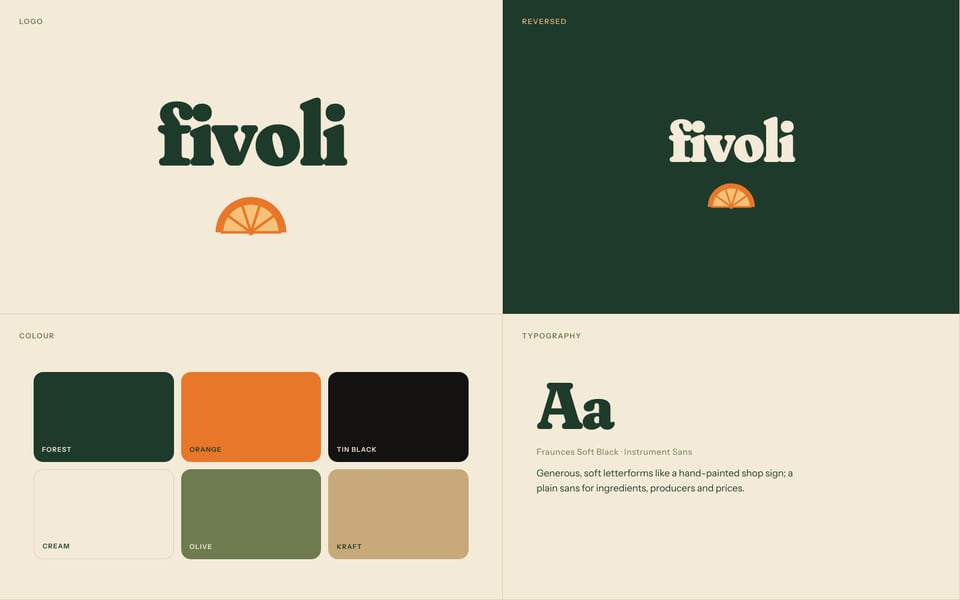
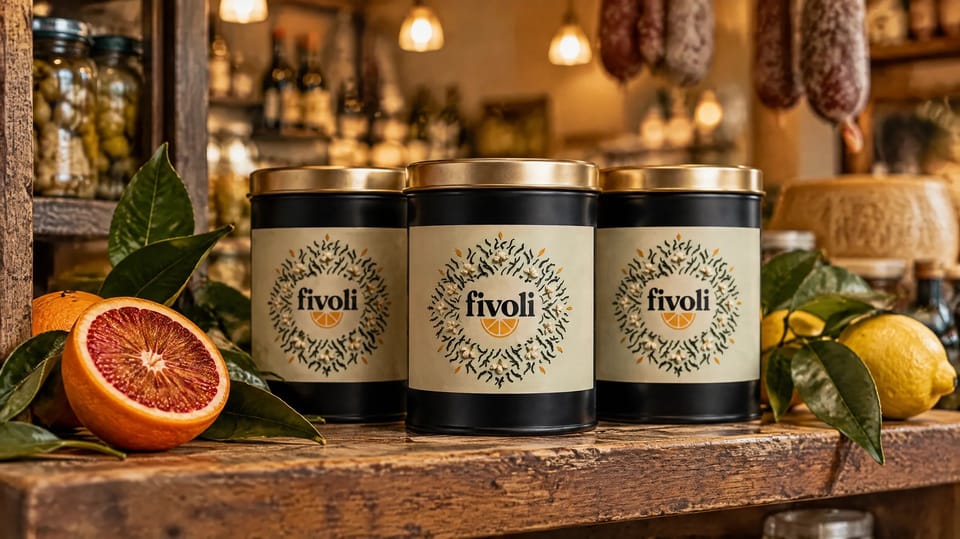
Fivoli is a studio concept: a fictional range of Mediterranean citrus preserves for delicatessens and an online shop, created by the Brandtune studio. It is not a client and has no market results. Its architecture is a branded house. One generous wordmark and a hand-drawn citrus wreath frame every jar, so many flavors read as one family; the flavors are descriptors inside one label system, not sub-brands, and the shop is built around the gift box rather than around separate lines.
Hypothetical example, not part of the published concept: suppose Fivoli wanted to add a savory line for home cooks, sold next to the preserves. Step 1: same buyer, same need? Partly; the buyer overlaps, but the need is cooking rather than breakfast or gifting. Step 2: would the Fivoli name help? Yes, it carries the same promise of slow, careful making. Step 3: does the line need its own store or tone? No; it can share the shop, the cart and the gift box. The tree allows a sub-brand at most, and the checklist pulls it back to a range: a separate collection in the same shop, the wreath kept, and olive, which is already in the palette, used to tell the two shelves apart.
Fivoli has no sub-brands, so the example above stays labeled hypothetical. To test a sub-brand on your own range, draw the structure before you design anything: the parent at the top, each line under it with its name, its buyer and the one element it borrows from the parent. Then sketch the store header and one collection page for each line. If the sketch needs a second header or a second cart, you are no longer looking at a sub-brand.
How do you name sub-brands and ranges consistently?
Pick one naming pattern for each level of the architecture and write it into the guidelines. Then decide the order in which names combine, and use that order everywhere a product is named.
A workable set of levels: the master brand has a proper or invented name; ranges have descriptive names that say what the product is or when you use it; sub-brands, if there are any, have a short proper name with the same sound and length as the parent. Mixing patterns on one level, one range with a descriptive name and the next with an invented one, is what makes a store feel unplanned.
The order matters as much as the names: parent first or line first, with or without a connecting word, and in which case. Product titles on the store, the front of the pack and email subject lines should all follow it. For finding the names themselves, follow our guide on how to name a brand; a sub-brand deserves the same brief and the same spoken test as the parent.
How does brand architecture show up on an online store?
It shows up in six places: the header, the navigation, product titles, web addresses, packaging and the emails around an order. If those six disagree with the strategy document, customers believe the store, not the document.
The header and the logo. In a branded house the parent logo leads on every page. With endorsed brands, each line's area or store leads with its own mark and carries the parent as a signature, usually beside the logo or in the footer.
Navigation and collections. Ranges become collections. Sub-brands can become collections with their own banner and accent color, still inside one menu. The home page should still say what the whole store sells before it introduces any line; our guide on ecommerce homepage design sets out that order.
Product titles. One order for every title, for example parent, line, product, variant. Consistent titles also make the catalog easier to search, inside the store and from search engines.
Web addresses. Ranges and sub-brands usually live as paths on one domain. A separate domain is a house-of-brands decision, and it means building a second site's audience from the beginning.
Packaging. The architecture decides what is printed largest on the front. If the parent's name is the largest thing on the pack, you have a branded house, whatever the plan says.
Email and checkout. The sender name, the order confirmation and the parcel should match the brand the customer believes they bought from.
When should you change your brand architecture?
Change it when the current structure causes confusion you can see, or before a launch it cannot hold. Changing it is a partial rebrand, so the same rule applies: keep what customers already recognize.
The visible signs are specific: customers buy the wrong line, support explains the difference between two ranges every week, or one line has grown a buyer the parent no longer suits. Moving from many names to fewer is usually easier on customers than the reverse, because it gives them less to remember.
Our guide on what to keep when you rebrand covers the order of work, and the new rules belong in your brand guidelines. If you are designing the identity and the store together, our ecommerce branding service plans how new products and lines will sit in both.
Frequently asked questions
What is brand architecture?
It is the structure that shows how a company's brand, product ranges and sub-brands relate to each other: which name leads, which ones borrow it and which stand alone. It decides what customers see in the store header, on the pack and in product titles.
What is a branded house?
A branded house puts one master brand on everything and gives products and ranges descriptive names. Every launch benefits from the parent's reputation, and it is the simplest structure to run with one store.
What is a house of brands?
A house of brands is a company that owns several separate brands with no visible link between them. Each can target its own buyer and tone, but each has to build its identity, store and audience from zero.
What is an endorsed brand?
An endorsed brand has its own name and identity and carries the parent as a smaller signature, typically its name followed by "by" and the parent's name. The line leads, and the parent lends it trust.
How does brand architecture affect an ecommerce store?
It decides whether you run one store or several, what leads the header, how collections and product titles are named, which domain or path each line lives on and whose name is on the order emails. Unclear architecture shows up as customers buying the wrong line.
Do small brands need brand architecture?
They need one decision: everything stays under one name until a line clearly needs its own. Writing that rule down, with a naming pattern for ranges, is a small brand's whole architecture, and it prevents most of the problems that make larger brands reorganize later.