Tools · 9 min read
Brand archetypes: the 12 types and how to choose yours
Brand archetypes are twelve recurring characters, borrowed from Carl Jung's idea of shared human patterns, that describe the role a brand plays for its customer: the Caregiver protects, the Explorer frees, the Jester lightens the day. Choose one lead and one modifier, then prove the pair on the pack, the store and the copy.
By the Brandtune studio · Last reviewed 23 Nov 2026
In short
- Choose the archetype from the customer's motive, not from how the team sees itself.
- One lead plus one modifier is specific; three archetypes is a mood, not a direction.
- An archetype only counts once it changes a type, color, photo or copy decision.
The short answer
An archetype is a shortcut for the part your brand plays in a customer's day. It is useful because it is familiar: people recognize a Caregiver or a Rebel without being told. It is dangerous for the same reason, because a familiar character copied without care looks like every other brand that chose it. Use it to make design and copy decisions faster, never as the brand itself.
What are the 12 brand archetypes?
The usual set has twelve. We sort them by what the customer wants from the purchase, because that is the question a consumer brand has to answer on the shelf and on the product page. The grouping is ours; the twelve names are the common ones.
Reassure me. The Innocent (simple, honest, nothing to worry about), the Caregiver (looks after you or someone you love) and the Ruler (control, quality, order).
Help me get better. The Hero (effort and achievement), the Sage (knowledge and proof) and the Creator (make something of your own).
Take me somewhere else. The Explorer (freedom, the outdoors, the new), the Outlaw or Rebel (break the category's rules) and the Magician (transformation, a before and after).
Let me belong. The Everyman or Regular Guy (for people like us), the Lover (pleasure, closeness, the senses) and the Jester (fun, wit, a lighter day).
How is an archetype different from brand personality and voice?
The archetype is the role. Brand personality is the set of traits that role is played with, and voice is how those traits sound in words. Two Caregiver brands can have opposite personalities: one brisk and clinical, one warm and chatty. The archetype tells you which story you are in; the personality tells you which character you are in it.
That is why an archetype on its own rarely settles a design. It narrows the field. The personality traits and the brand voice guidelines then do the finer work.
How do you choose a brand archetype? Pick, pair, prove
We use three steps. Each one has a test, and a candidate that fails the test is dropped before anyone draws anything.
1. Pick from the customer's motive. Write the sentence a happy customer would say after the purchase: "Now I don't have to think about it" points to Innocent or Caregiver; "I finally did it" points to Hero or Creator. If you cannot write that sentence, you need the answers from a brand discovery questionnaire first. Test: would a customer, not the founder, recognize the sentence?
2. Pair it with one modifier. A single archetype is crowded; most categories already have a dominant one. Add a second archetype that bends the first: a Sage with some Jester explains without lecturing, an Explorer with some Caregiver takes you outdoors and brings you home safe. Keep the modifier clearly smaller. Test: can you describe the pair in one sentence without the word "and" doing all the work?
3. Prove it in six places. Translate the pair into a decision for type, color behavior, photography, packaging or product page structure, the first line of copy and one moment of service, such as the order confirmation. Test: if two of the six decisions would be the same for the opposite archetype, the choice has not changed anything yet.
What does each archetype look like on a pack and a store?
Read the table across. The third column is where an archetype earns its place: the visible choices it should push you toward. The last column is the version a brand slides into when it plays the character too hard, which is usually what the category's weaker brands already look like.
| Archetype | What the customer wants | On the pack and the store | Overdone, it becomes |
|---|---|---|---|
| Innocent | Simple, safe, nothing to decode | Short ingredient lists, plenty of white space, plain words | Bland and childish |
| Caregiver | Someone looking after them | Reassuring photography, clear instructions, generous service notes | Smothering or preachy |
| Ruler | Control and dependable quality | Strict grid, restrained palette, specifications up front | Cold and distant |
| Hero | To achieve something hard | Strong type, motion in photography, results-led product pages | Shouting and macho |
| Sage | To understand before buying | Explanations, comparison tables, a calm serif or precise sans | Lecturing |
| Creator | To make something their own | Process imagery, tools on show, room for customization | Fussy and unfinished |
| Explorer | Freedom and the new | Wide crops, natural materials, routes and places in the copy | Generic adventure stock |
| Outlaw | To break the category's rules | Unexpected color, blunt headlines, packaging that ignores the shelf norm | Edgy for its own sake |
| Magician | A visible transformation | Before and after, reveals, a signature moment in the unboxing | Overpromising |
| Everyman | A brand for people like them | Familiar formats, everyday settings, plain prices and plain names | Forgettable |
| Lover | Pleasure and closeness | Texture, close-ups, warm color, sensory words | Cloying |
| Jester | A lighter moment | Bright color, playful names, jokes on the pack flap | Tiring after the third joke |
The worksheet: score three candidates before you commit
Copy this into a document and fill it in with two or three people who know your customers. Score each candidate 0 (no), 1 (partly) or 2 (clearly) on the four questions. The highest total is the lead; the runner-up is the first candidate for the modifier.
Customer sentence after purchase: ______
Candidate A: ______ · Candidate B: ______ · Candidate C: ______
Q1 Motive. Does it match the customer sentence? A __ / B __ / C __
Q2 Distance. Is it different from the archetype the category's best-known brands already play? A __ / B __ / C __
Q3 Sustain. Can the business behave like this every day, in service, delivery and returns, not only in a campaign? A __ / B __ / C __
Q4 Levers. Can you name a type, color and photography decision it changes? A __ / B __ / C __
Totals: A __ / B __ / C __ · Lead: ______ · Modifier: ______ · One-sentence pair: ______
A tie between two candidates is useful information: it usually means the customer sentence is still too vague. Rewrite it and score again.
What does this look like on a real brief? A hypothetical reading of two studio concepts
Fivoli and Muro are studio concepts, and neither was briefed with archetypes. Reading them through the lens afterwards shows how the method works; treat it as a hypothetical example, not a record of how they were made.
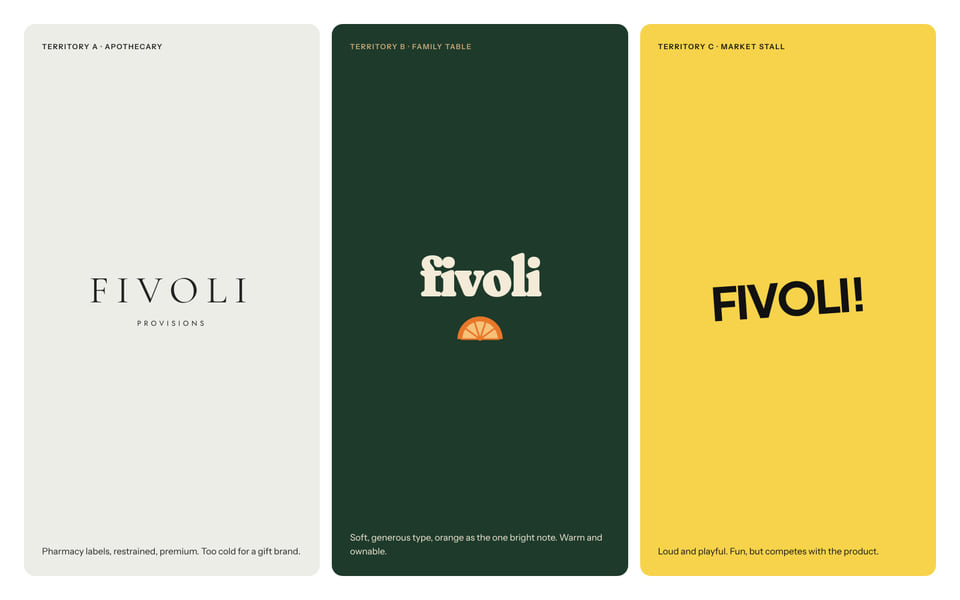
Fivoli, a range of citrus preserves, explored three territories. Apothecary was set aside as too cold for something people give as a present, and market stall competed with the product on a busy deli shelf. Family table won. Read as archetypes, apothecary leans Sage, market stall leans Everyman, and family table sits closer to Caregiver with a Lover modifier: generosity, the hand-drawn citrus wreath, the jar as a gift. The pick failed on motive for one territory and on distance for the other.
Muro, a bean-to-bar chocolate concept, kept one product and tested three store directions: Loud, Reserved and Club. Loud plays like a Jester, Reserved like a Sage with Ruler restraint, Club like an Everyman built around a monthly new wrapper. Same bar, three archetypes, three different first screens. That is the point of step 3: the archetype is only real once the screen changes.
When do brand archetypes mislead you?
When the team picks its self-image. Founders often choose Hero or Magician because it flatters the company. Score against the customer sentence, not the pitch deck.
When the archetype becomes a stock photo. Explorer does not have to mean a mountain ridge, and Lover does not have to mean soft focus. Find the archetype in a detail that only your product has.
When it replaces positioning. An archetype says what role you play, not whom you beat or why you are worth choosing. That belongs to brand strategy and to a brand messaging framework.
When an existing brand switches archetype overnight. If customers already know you as a Caregiver, a sudden Outlaw campaign reads as a different company. Run a brand audit first and move one step at a time.
What should you do with the archetype once you have it?
Write the one-sentence pair at the top of your strategy page, next to the customer sentence. Then hand it to whoever designs the identity with the six proof decisions already listed, so the archetype arrives as instructions rather than as a label. If you would rather work it out with the studio, brand strategy covers the archetype, personality and positioning together, and the guide to what brand identity is shows where each decision lands.
Frequently asked questions
What are brand archetypes?
Twelve recurring characters, adapted from Carl Jung's idea of shared human patterns, that describe the role a brand plays for its customer. Each one stands for a motive, such as safety, mastery, freedom or belonging.
What are the 12 brand archetypes?
Innocent, Caregiver, Ruler, Hero, Sage, Creator, Explorer, Outlaw, Magician, Everyman, Lover and Jester. Some lists use Rebel for Outlaw and Regular Guy for Everyman.
Can a brand have more than one archetype?
Yes, but keep one as the lead and one smaller modifier. A third archetype usually blurs the direction instead of sharpening it.
How do I find my brand archetype?
Write the sentence a happy customer would say after buying, match it to the archetype's motive, then check that it differs from your category and that the business can live it every day. The worksheet above scores three candidates on those questions.
Is a brand archetype the same as brand personality?
No. The archetype is the role the brand plays; the personality is the set of traits it plays the role with. Two brands with the same archetype can have very different personalities.
Do small brands need an archetype?
Not as a formal exercise, but the question behind it helps any brand: what does the customer want from us? Answer that clearly and the archetype often follows without a workshop.
Should a rebrand change the archetype?
Only when the customer's reason to buy has changed. If it has not, keep the archetype and change how it is expressed, so existing customers still recognize you.