Tools · 8 min read
Brand personality: how to define traits customers can see
Brand personality is the set of human traits people would use to describe a brand if it walked into the room: warm or cool, precise or relaxed, playful or serious. Pick three to five traits, give each one a "but not" limit, and turn every trait into a visible choice in type, color, photography, words and service.
By the Brandtune studio · Last reviewed 23 Nov 2026
In short
- Three to five traits, each with a "but not" that stops it going too far.
- A trait is only real when it changes type, color, photography, words or service.
- Test it by asking strangers to describe the store in three words, then compare.
The short answer
Customers describe brands the way they describe people, whether you plan for it or not. Defining a brand personality means choosing the description you want and then making design and behavior decisions that earn it. A list of adjectives is the start; the work is translating each one into something a customer can see on the pack, the product page and the delivery.
How is brand personality different from archetype, voice and values?
Four terms get mixed up, so here is how we keep them apart. Values are the principles behind decisions. The archetype is the role the brand plays for the customer. Personality is the set of traits it plays that role with. Voice is how those traits sound in words, and it gets its own rules in brand voice guidelines.
Personality is the layer that reaches furthest. Voice covers words; personality also covers the typeface, the color temperature, how a photograph is lit, how fast a reply arrives and how a refund is handled.
How do you define a brand personality? Trait, but not, shows as
We write the personality as a set of three-part lines. Each line fixes one trait, limits it and makes it visible.
Trait. One adjective a customer might use. Choose words a customer would say, such as warm, sharp or cheerful, rather than strategy words such as innovative or customer-centric.
But not. The overdone version of the same trait. Warm, but not sugary. Confident, but not loud. The limit matters more than the trait, because most personality problems come from playing a good trait too hard.
Shows as. At least two concrete decisions, one visual and one in words or behavior. Warm shows as a soft serif and photographs in daylight, and as replies signed by a named person.
Three to five lines is the useful range. Fewer and the personality is generic; more and the traits start to contradict each other. If two traits pull against each other, such as playful and premium, keep both only if you can write a "shows as" line where they work together.
The worksheet: write your personality lines
Fill this in before any design work. Leave a line blank rather than writing a trait you cannot show.
1. Trait ______, but not ______. Shows as (visual) ______ and (words or service) ______.
2. Trait ______, but not ______. Shows as (visual) ______ and (words or service) ______.
3. Trait ______, but not ______. Shows as (visual) ______ and (words or service) ______.
4 (optional). Trait ______, but not ______. Shows as ______ and ______.
Never: one trait customers must never use about us ______.
Check: would a brand in the same category with the opposite personality write the same "shows as" lines? If yes, the lines are too vague. Make them specific to your product.
Most of the raw material for the traits is already in your answers to a brand discovery questionnaire; this worksheet turns those answers into instructions.
How do traits turn into design decisions?
The table below is a starting map for eight traits we see often in consumer and online brands. Treat the cues as defaults to argue with, not rules: a warm brand can still use a sans, but it should then find its warmth elsewhere, such as in color or photography. For the type column, the guide to brand fonts goes deeper.
| Trait, but not | Type | Color and photography | Words and service | Overdone, it becomes |
|---|---|---|---|---|
| Warm, but not sugary | Soft serif or rounded sans | Warm neutrals, daylight, hands in frame | Replies signed by a named person | Cloying, too many exclamation marks |
| Calm, but not clinical | Light weights, generous spacing | Muted palette, plenty of empty space | Short instructions in numbered steps | Cold and forgettable |
| Confident, but not loud | Strong weight, few sizes | One accent color used sparingly | Direct headlines, no hedging | Arrogant |
| Playful, but not silly | Expressive display face for one role only | Bright accents, unexpected crops | One joke per page, never in checkout | Tiring |
| Precise, but not cold | Clean sans, tabular figures for specs | Neutral ground, product sharp and centered | Exact measurements and clear options | Sterile |
| Generous, but not cluttered | Large, friendly headings | Full-bleed product photography | Gift notes, samples, easy returns | Busy and noisy |
| Crafted, but not precious | A serif with visible character | Texture, materials, close-ups of making | Process explained in plain words | Fussy and slow |
| Bold, but not chaotic | Heavy capitals in short lines | Strong pattern held to one zone of the page | Short sentences, one action per screen | Hard to shop |
What does this look like in practice? Three studio concepts
These are studio concepts, not client work, and the trait names are our hypothetical reading of decisions recorded for each one.
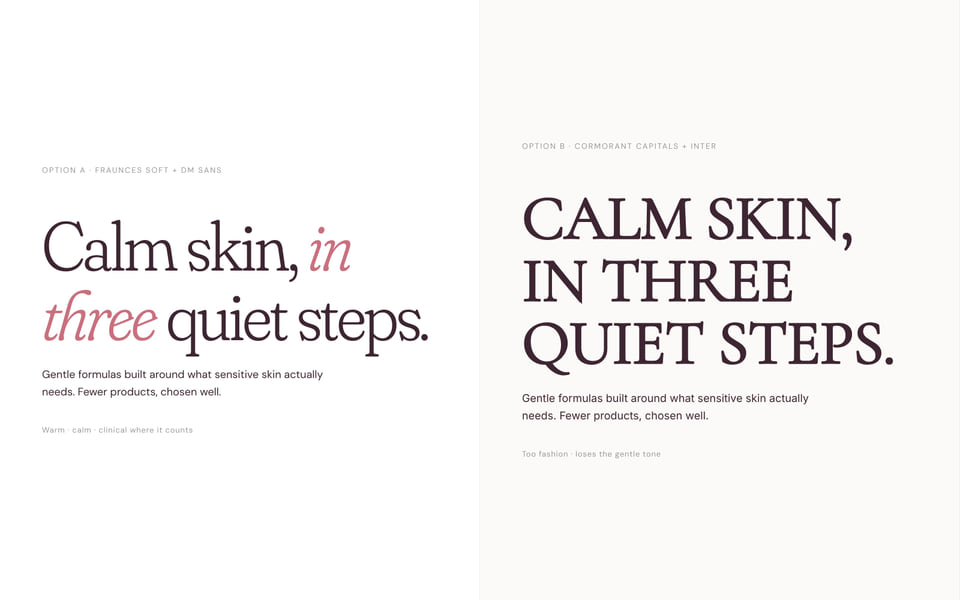
Purinea, gentle skincare. The brief was to feel clinical enough to trust and soft enough to love. Two type routes were drawn. Serif capitals were set aside as too fashion: they lost the gentle tone. As a personality line: calm, but not clinical; shows as a lowercase serif and a rose italic kept for one word.
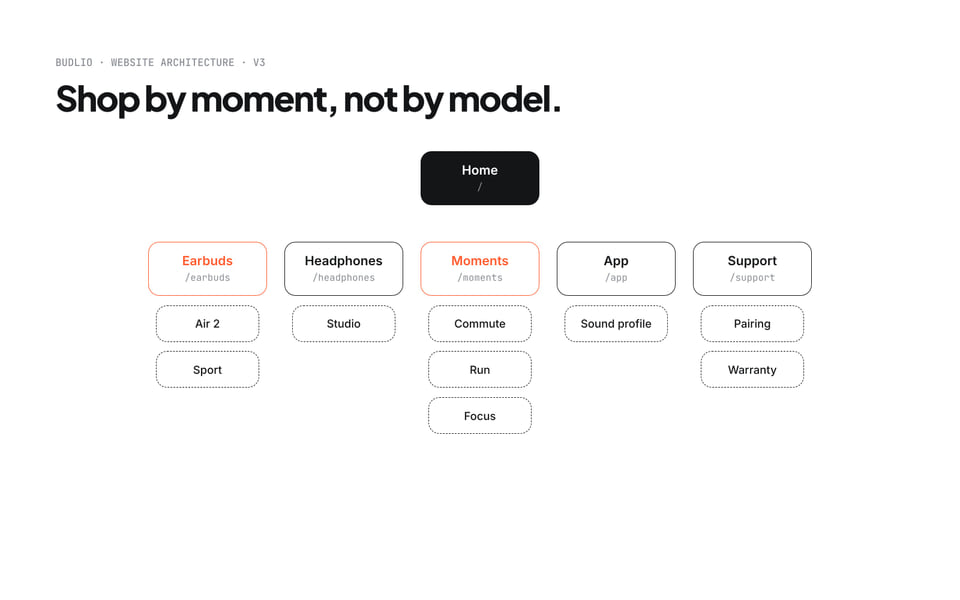
Budlio, consumer audio. The brief asked for a short, friendly name and a look that holds up on a phone screen and a station billboard. As a line: friendly, but not childish; shows as a rounded b, graphite with one signal orange, and a home page with one headline and one orange button.
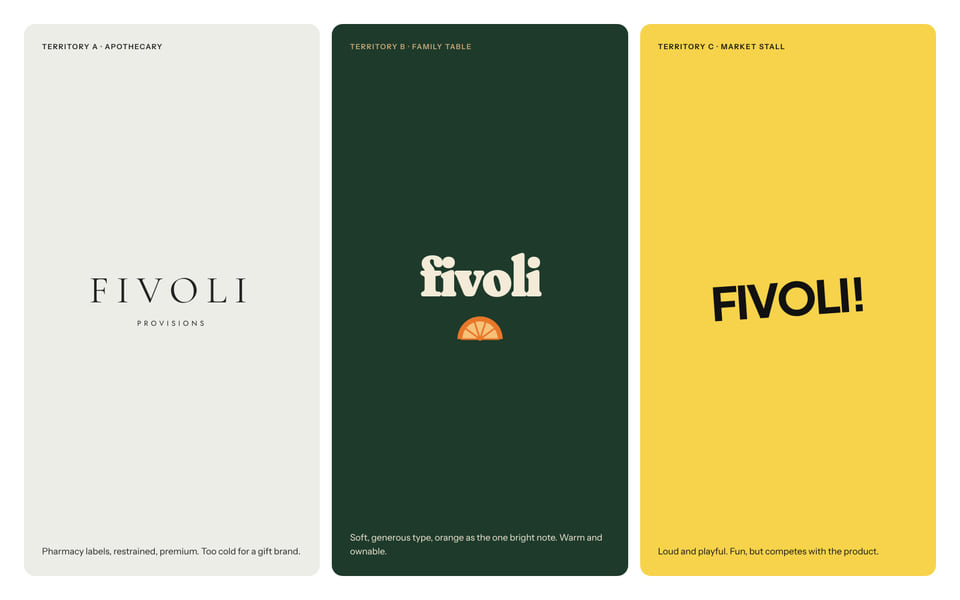
Muro, chocolate in three directions. One bar, three store directions. Loud uses heavy capitals and the wrapper pattern everywhere; Reserved uses a spaced serif on cream paper. Same product, two personalities, and the first screen changes completely. It shows why the "but not" line matters: Loud works only if it stays short of chaotic.
How do you test whether the personality is coming across?
Show the store's home page and one product page to five people who do not know the brand. Ask each for three words that describe it, without showing them your list. Then sort their words into three piles: matches a trait, matches a "but not", or unrelated.
Words in the "but not" pile tell you which trait is being overplayed. Unrelated words usually point to one element, often the photography, that belongs to a different brand. Repeat the test after changes; if you want the full picture across name, identity and store, a brand audit runs the same idea at a larger scale.
When should a brand personality change?
When the customer changes, not when the team gets bored. A brand moving from market stalls into a department store may need to sharpen a trait, but it should keep its "never" line. Shifting personality is easier than shifting archetype, and much easier than changing values, so it is often the right lever in a refresh.
If you want the personality defined alongside positioning, values and archetype, that is the work of brand strategy. The traits then feed the brand messaging framework and the identity design.
Frequently asked questions
What is brand personality?
The set of human traits customers associate with a brand, such as warm, precise or playful. It shows in design, words and behavior, not only in advertising.
How many personality traits should a brand have?
Three to five. Fewer tends to sound generic and more tends to contradict itself.
What is the difference between brand personality and brand voice?
Personality is the full set of traits; voice is how those traits sound in writing and speech. Personality also covers visuals and service.
What are the five dimensions of brand personality?
A widely used academic model groups traits into sincerity, excitement, competence, sophistication and ruggedness. It is useful for research; for designing a brand, specific traits with limits are easier to act on.
How do you describe a brand's personality?
Use words a customer would use, give each a limit ("warm, but not sugary") and list the design and service choices that show it. The worksheet above follows that pattern.
Can a brand personality change over time?
Yes, gradually and when customers or channels change. Keep at least one trait and the "never" line steady so existing customers still recognize the brand.
How do you know if your brand personality is working?
Ask people who do not know the brand to describe your store in three words and compare their words with your traits. Words that match a "but not" show which trait is being overplayed.