Tools · 8 min read
Brand values: how to write ones that change decisions
Brand values are the three to five principles a brand uses to make choices when nobody is checking: what it will do, what it refuses and what it gives up. A good value passes four tests. Someone could sensibly hold the opposite, it costs you something, a customer can see it, and it settles a tie.
By the Brandtune studio · Last reviewed 23 Nov 2026
In short
- If no sensible brand would claim the opposite, it is a hygiene factor, not a value.
- Every real value costs something: a sale, a margin, a shortcut, a customer.
- Write each value as a card: meaning, behavior, cost, proof and what it beats.
The short answer
Brand values are not a list of virtues. They are a short set of decisions made in advance, so that a designer, a customer service reply and a product launch all lean the same way without a meeting. Most value lists fail because they name things every company wants, such as quality, trust and innovation, and so they never decide anything. The fix is a filter, not better words.
What are brand values, and what are they not?
A brand value is a principle that changes behavior. It sits under the brand: it shapes what the brand says in its messaging framework, the role it plays as an archetype and the traits it shows as a personality, but it is not any of those things itself.
It is also not the same as brand value, singular, which usually means what a brand is worth to the business. And it is not a mission statement: the mission says where you are going, the values say how you will behave on the way.
There are three kinds of words that end up on value lists. Hygiene words are things every business must do anyway, like honesty or safety. Aspirations are things you wish were true but cannot show yet. Working values are true today, visible to customers and costly to keep. Only the third kind belongs on the list. Keep hygiene words in your policies and aspirations in your plans.
How do you test whether a value is real? The four tests
Run every candidate through these tests in order. A value that fails one is rewritten or removed.
1. The opposite test. Could a sensible competitor proudly hold the opposite? "We value quality" fails, because nobody stands for poor quality. "We make fewer things and keep them in stock" passes, because plenty of brands sensibly choose a wide, changing range.
2. The cost test. Name one thing this value has cost, or will cost, the business: a product you did not launch, a channel you stay out of, a discount you refuse. If it has never cost anything, it has never been tested.
3. The evidence test. Point to where a customer can see it without being told: on the pack, in the store, in the delivery, in a reply. If the only evidence is the About page, it is a claim.
4. The tie-break test. Put two values side by side and decide which wins when they collide. Speed against care, choice against simplicity. Writing the order down is what makes values useful on a busy day.
The value card: a template to fill in
Write one card per value. Five lines are enough; if a line will not fill, the value is not ready.
Value (two to five words): ______
What we mean by it, in one sentence a customer would understand: ______
What we do because of it (one behavior you could film): ______
What it costs us (one thing we give up): ______
Where a customer sees it (one place, one detail): ______
It wins over ______ when the two collide.
Keep the finished cards to one page. Three to five cards is the usual range; more than five and the tie-break line stops working, because nobody remembers the order.
How do you rewrite a generic value into a usable one?
Start from the generic word, ask what it would look like on an ordinary Tuesday, and write that instead. The table below shows the pattern on seven of the words that appear on most value lists, with sharpened versions written for a hypothetical consumer brand. The rewrites are examples of the method, not values to copy.
| Generic value | Test it fails | Sharpened version | Where a customer would see it |
|---|---|---|---|
| Quality | Opposite: nobody claims poor quality | We reformulate before we add a new product | A short range; a dated note on each change |
| Trust | Evidence: trust is the result, not the behavior | We show the full ingredient list before the price | Ingredients above the fold on every product page |
| Innovation | Cost: rarely costs anything to say | We retire a product every time we launch one | A small, stable catalog with a clear archive |
| Customer first | Tie-break: never says what it beats | Returns are easy even when it hurts the margin | A returns page a customer can read in a minute |
| Sustainability | Evidence: often an aspiration | Refills cost the customer less effort than a new bottle | A refill option on the product page, not a separate site |
| Passion | Opposite and evidence | Drop it: a hygiene word | Nowhere; let the work show it |
| Community | Evidence: often an aspiration | Move it to plans until there is something to show | Later, when it exists |
What does a finished set look like? A hypothetical example
Hypothetical example, not a real brand or client: an online shop selling houseplants by post. The founders' first list read "quality, sustainability, community, passion". After the four tests, it became three cards.
Healthy on arrival. We only ship a plant when the weather on the route is safe for it. Costs us: orders delayed in cold weeks. Seen in: the delivery date shown at checkout, with the reason. Wins over speed.
One plant, one care card. Every plant ships with its own instructions, not a general leaflet. Costs us: printing and packing time. Seen in: the card in the box and the matching page on the store. Wins over range size.
Fewer, hardier plants. We stock plants that forgive beginners. Costs us: the rare, fashionable plants other shops sell. Seen in: a short catalog with a difficulty note on each product. Wins over novelty.
"Passion" was dropped as a hygiene word. "Sustainability" became part of the first card, where it could be shown, instead of a claim the shop could not yet support. "Community" was moved to the plans list as an aspiration.
How do values show up in the identity and the store?
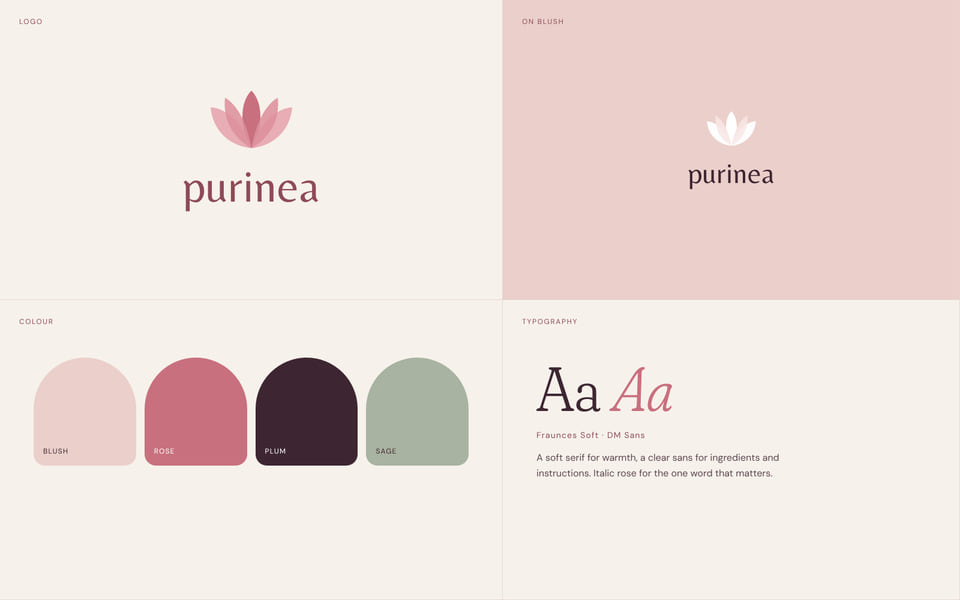
Values are decided in words, but customers meet them in design. Purinea, a studio concept for sensitive skin, shows the link: its idea is "calm skin, in three quiet steps", and the store keeps one routine per skin need. Read as a value (our hypothetical reading, since the concept was not built from a values list), restraint becomes a short range, a quiet palette and a rose italic kept for the one word that matters.
For your own brand, take each card's evidence line and give it to the designer as a requirement. A value like "fewer, hardier plants" turns into a short navigation and a difficulty label on every product tile. That is where values stop being a poster and start making the store easier to use. The same cards should steer the tone in your brand voice guidelines, so a value about restraint never arrives in shouting copy.
How often should brand values change, and who owns them?
Rarely. Review the cards once a year or when the business changes shape, such as a new channel or a new product line. A value that keeps failing the evidence test is either being ignored or was an aspiration all along; a brand audit will show which.
One person should own the page and settle tie-breaks. If you want to write values together with positioning and personality, the studio's brand strategy work starts there, and the brand discovery questionnaire collects the raw material before the first session.
Frequently asked questions
What are brand values?
The three to five principles a brand uses to make decisions, especially ones that cost it something. They guide design, copy, service and product choices in the same direction.
How many brand values should a brand have?
Usually three to five. Fewer can be fine for a small brand; more than five makes it hard to remember which one wins when two collide.
What is the difference between brand values and brand value?
Brand values are principles that guide behavior. Brand value, singular, usually means what the brand is worth to the business.
What are examples of good brand values?
Good ones are specific and costly, such as "we only ship when the weather on the route is safe for the plant". Single words like quality or trust are starting points that still need rewriting.
How are brand values different from a mission statement?
The mission says what the brand is trying to achieve. The values say how it will behave while it tries.
Should brand values be on the website?
The behavior should be visible everywhere; the list itself is optional. A short values page helps if every value links to something a customer can check.
Who should write a brand's values?
The founders or leadership, with input from the people who talk to customers every day. One person should own the final page and settle disagreements.