Branding for small businesses
Branding package for small businesses
A branding package for a small consumer business, built as a scope ladder. We agree in writing which rung you need now: a name, a minimum identity, a one-page guide or a website. The work matches your stage, and each rung is made so the next one can be added later without starting again.
What the branding for small businesses project covers.
Agreed in writing before design starts, so you know what is in the project and what is not.
- Choosing the rung
A short call and a written answer on which rung of the ladder your business needs now and which can wait.
- Scope closed in writing
The package is a written list of what is made, how many rounds of feedback it includes and what is left out.
- Minimum identity
A mark or wordmark, a small palette and one or two typefaces, tested at the sizes you actually use.
- One-page guide
The rules on a single page, so a printer, a freelancer or a new hire can use the brand correctly.
- Files for the places you sell
Versions for the label, the social avatar, the shop sign or stall and the website header.
- The next rung, noted
A short note on what to do next and what would tell you it is time.
The scope ladder: what to do first when the budget is small
Four rungs, each one useful on its own and each one the base for the next, so a small budget buys the right piece first.
What a branding package means here
A branding package is a scope closed in writing. Before work starts you get a list of what will be made, how many rounds of feedback are included and what is deliberately left out. No surprise extras, and no paying for pieces a business of your size will not use yet.
We do not publish rates on this page, because the cost follows the scope. Our guide to branding cost factors explains which choices make a project larger or smaller, so you can decide what to ask for.
The scope ladder, rung by rung
- Rung 1. Name. Only if you have no name yet or the current one is causing real trouble: misheard, misspelled or too narrow for what you sell. See brand naming.
- Rung 2. Minimum identity. A mark or wordmark, a small palette and one or two typefaces, tested on your label, your social avatar and your sign. Enough to look like one business everywhere.
- Rung 3. One-page guide. The rules on a single page: logo versions, clear space, colors, type and two or three dos and don'ts. Enough for a printer or a freelancer to get it right.
- Rung 4. Website. A site or store built on the identity, when customers need to find, trust or buy from you online.
- Our rung now: ______ Next rung, and the sign it is time: ______
| Stage of the business | Deliverable | What to expect |
|---|---|---|
| An idea, no name yet | Rung 1 and rung 2: name and minimum identity | A naming brief and a shortlist first; the mark is drawn only after the name is chosen. |
| Launching the first product | Rung 2 and rung 3: minimum identity and one-page guide | Files for the label, the social avatar and the sign, and one page someone else can follow. |
| Trading, but the look has drifted | Rung 3, built from what you already have | A review of what is in use, what customers recognize is kept, and the rules written on one page. |
| Most sales happen online | Rung 2, then rung 4 | The identity settled first, then a store built on it, so the site does not need redoing. |
| Adding a range or a new channel | An extension of rung 3 | The guide extended to cover new packs, a marketplace listing or a shop window. |
| The first identity no longer fits | A rebranding, not a new rung | An audit of what to keep before anything is redrawn. |
How to pick your rung
Answer three questions. Do you have a name you can keep? If yes, skip rung 1. Do customers see the same business on your label, your posts and your sign? If not, rung 2 is the gap. Does anyone other than you make things with the brand? If yes, rung 3 saves time and mistakes every week.
The website is the last rung for many small consumer businesses, not the first, because a site built before the identity is settled is usually redesigned soon after. If most of your sales already happen online, the order changes, and the table below shows how.
What a small business can leave for later
A full guidelines book, a brand architecture for one product, a large photo shoot and a dozen logo lockups are all useful at the right moment, and most of them can wait. A brand kit with the files you use every day does more for a small team than a long manual nobody opens.
When the team grows, the one-page guide becomes the first page of full brand guidelines, so nothing written now is thrown away.
Why each rung is built to carry the next
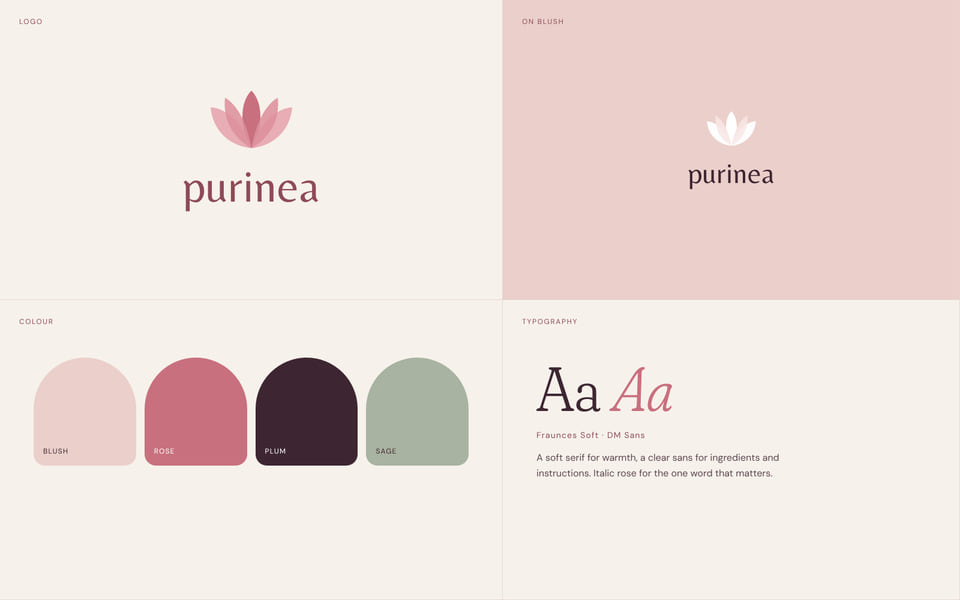
A minimum identity is not a cut-down identity. It is the core every later piece is built on. The Purinea studio concept fits on one board: a five-petal lotus, a lowercase wordmark, four colors and two typefaces. That is roughly the size of a minimum identity, and everything else, from the pack to the store, grows from it.
We deliver files in the formats the next rung needs, so the person who builds your e-commerce website or draws a refined logo later starts from the same source.
When it is time to climb
The signs are practical: posts that look like three different businesses, a new product that does not fit the label, a new channel such as a marketplace or a shop, or a team member who keeps asking which logo to use.
If the first identity no longer fits what the business has become, the next step is not another rung but a rebranding. Our guide on whether to refresh or rebuild helps you tell the two apart.
What you receive at the end.
What you receive at the end of the project.
- A written scope: the rung, the deliverables and what is out
- The identity files for each place you sell
- A one-page brand guide
- A website, when that rung is in scope
- A note on the next rung
How the project runs.
Four steps, each with something you can approve before the next one starts. The schedule for each is written into the proposal.
Choose the rung
Where the business is, what customers see first and what is already working.
The rung and a written scope.
Brief
What the brand must say, to whom and where.
A one-page brief.
Design
The work for that rung, checked at real sizes and in real places.
The identity, guide or site.
Hand over
Files sorted by use, the guide and the next-rung note.
Everything you need to run the brand yourself.
Related work.
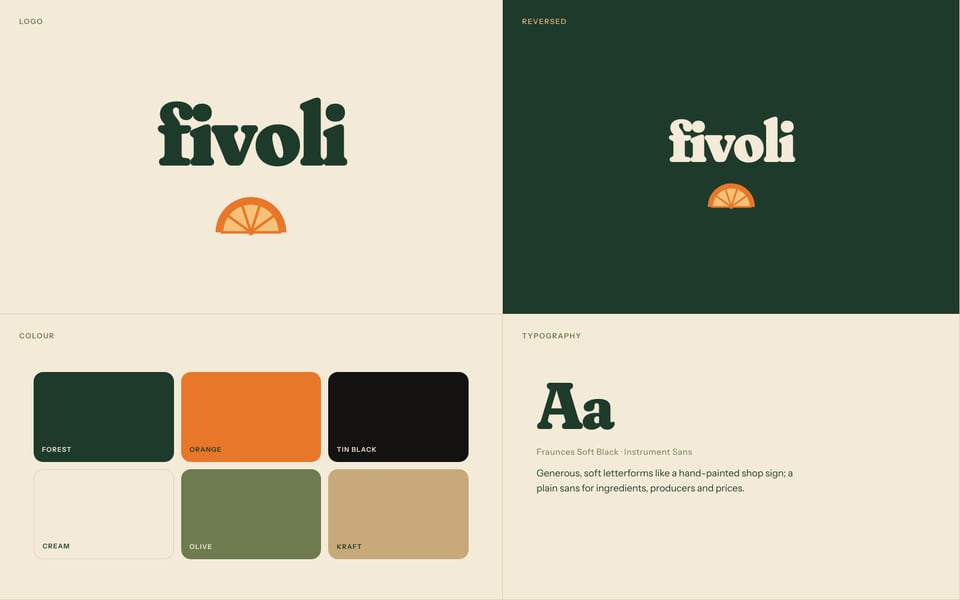
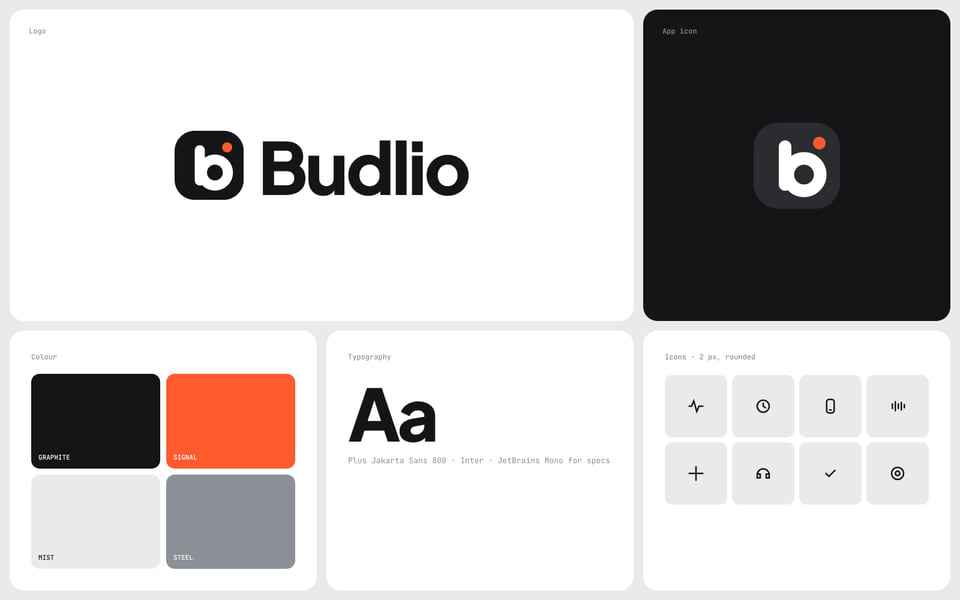
Self-initiated studio concepts, each with its identity, applications and website.
Common questions
About branding for small businesses
What is a branding package?
Here it means a scope closed in writing: a fixed list of what is made, the rounds of feedback included and what is left out. You know what you get before work starts.
Can we start with only a logo?
Yes, as part of a minimum identity: the mark plus the colors and type that make it usable. A logo on its own leaves every other choice open.
Do we need a website now?
Not always. If customers find you through a shop, a stall or a marketplace, the identity and guide may come first and the site later.
Can we add the next rung later?
Yes. Each rung is built so the next one starts from it, not from scratch.
We already have a logo. Where do we start?
From what you have. We look at what customers already recognize and decide with you whether a one-page guide is enough or the identity needs work.
How many rounds of changes are included?
The number is written into the scope before work starts.
What do we need to prepare?
A short description of what you sell, who buys it and where they meet you, plus anything you already use: a logo, photos, a site.
Also as one project
Brand guidelines, planned with this one.
Brand guidelines are the document that tells your team, your freelancers and your store builder how the brand looks and sounds, with right and wrong examples side by side. We write and design them in the format your brand actually needs: a short style guide, a full brand book or a kit of ready templates.
Tell us where your business is now.
A short request, a call to agree the brief, then a proposal with scope and schedule in writing.
Scope and schedule in writing before design starts.
- 01You tell us about the project in a short request.
- 02A short call to agree what the project needs.
- 03A proposal with scope and schedule in writing.