Real estate branding
Real estate branding for a building that is not built yet
Real estate branding for a new development has to work before there is anything to photograph. We plan the brand across five phases, from bare site to the years residents live there, and design the piece that speaks in each one: the name, the site fence, the sales material, the website, the signs and the handover pack.

What the real estate branding project covers.
Agreed in writing before design starts, so you know what is in the project and what is not.
- A five-phase site sheet
The brand pieces a project needs from the day the plot is announced to the years after move-in, with who owns each piece in each phase.
- A name for the place, not only the company
A development name and mark that can live on a fence, a brochure, a front door and a mailing address.
- Site fence and construction signs
Hoarding panels and site signs designed as the first large brand surface, readable from a car and from the sidewalk.
- Sales material without a finished building
Brochure, floor-plan sheets and sales suite pieces designed around renders, plans and real material samples.
- A website that changes with the phases
The brand side of a site that starts as a single announcement page, grows into availability and plans, then becomes a page for residents.
- A handover kit
Wayfinding, mailbox and door signs and a welcome pack, so the brand that sold the building is the one people live with.
How we brand a development: the five-phase site sheet
A planning sheet for one property, usable with us or on your own.
Why would a consumer brand studio work on property?
Because a new development is sold more like a product launch than most people assume. It needs a name, a launch surface, a page buyers compare on a phone and, at the end, a physical object: the front door. Our brand identity practice is built around that sequence.
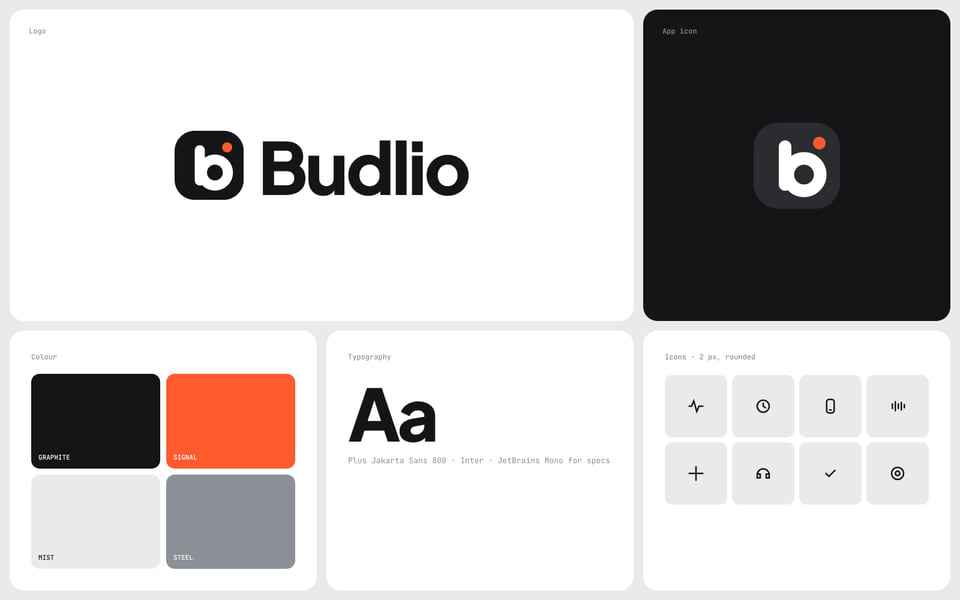
We say it plainly: Brandtune has no real estate clients. The images here are studio concepts from consumer categories, such as Budlio, and the building described below is hypothetical. What we offer a developer is the method.
A building has a harder problem than an agent
Much of what is written on this subject covers personal branding for agents: a headshot, a logo, a consistent feed. A development faces something harder. Its brand has to persuade buyers for months or years before the product exists, then hand over to people who may never have seen the sales campaign.
That is why our tool is organized by time rather than by channel. The site sheet has five phases, and for each one it asks who meets the brand, what they can actually see and which piece has to carry the message.
The five phases, from bare site to lived-in
Announced: the plot is known, nothing is built, and the name and a first page do all the work. Under construction: the site fence becomes the largest surface the brand will ever have, and neighbors pass it every day. Sales: brochures, floor plans and the sales suite are studied closely, usually on renders. Move-in: wayfinding, door signs and the welcome pack meet the people who bought. Lived-in: the brand becomes an address, looked after by a property manager.
The table below shows the sheet we start from. Phases overlap in practice, since sales often opens during construction, so each piece gets a start phase and an end phase instead of a single slot.
| Phase | Who meets the brand | What they can see | Piece that speaks | Who looks after it |
|---|---|---|---|---|
| Announced | Early buyers, agents, the neighborhood | A plot, a name, a location | Name, mark and a first web page | Developer |
| Under construction | Neighbors, passers-by, drivers | Fence, cranes, site entrance | Hoarding panels and site signs | Developer and sign maker |
| Sales | Buyers comparing options | Renders, plans, a material board | Brochure, floor-plan sheets, sales suite, website | Sales team |
| Sales | Agents presenting the project | Their own screens and printouts | Presentation and listing templates | Sales team and agents |
| Move-in | New residents | Entrance, corridors, mailboxes | Wayfinding, door signs, welcome pack | Developer, then property manager |
| Lived-in | Residents and visitors | The address and the lobby | Exterior sign, lobby directory, notices | Property manager |
Name the place before anyone draws a logo
A development name has to work on a fence, a brochure, an envelope and in a casual conversation between neighbors. It should not lean on a view or a feature the finished building might not deliver. In brand naming we test candidates against all four uses before a mark is drawn.
Brokerages face the same question in another form: whose name leads, the firm's or the agent's? We settle that hierarchy early, in brand strategy, because it decides every sign, business card and listing template that follows.
Sell with what you have: renders, plans and materials
Before completion the honest assets are drawings, renders, a material board and the neighborhood itself. The identity has to frame them without overselling them. We set rules for how renders are labeled as renders, how floor plans are drawn and which real material, a brick, a tile or a timber sample, sits in the sales suite.
Printed pieces from the sales phase behave like a product range: brochure, floor-plan sheets, a folder, perhaps a small box of samples a buyer takes home. We design them with the discipline of packaging design, one system across every format and size.
Fill in the site sheet for your own project
- Phase (announced, under construction, sales, move-in, lived-in): ______
- Who meets the brand in this phase (neighbors, buyers, agents, residents): ______
- What they can actually see or hold: ______
- Brand piece that carries the message: ______
- Start phase and end phase for that piece: ______
- Who owns and updates it (developer, sales team, sign maker, property manager): ______
- What is retired when the phase ends: ______
Hypothetical example: a residential building on a corner lot
Hypothetical example. Picture a developer planning a single residential building on a busy corner, with sales opening while the frame goes up. The filled-in sheet shows one surface that outweighs all the others for most of the project: the fence along two streets, passed by the same people every morning.
So the fence is designed first, and in stages: the name and a short line about the place while the site is cleared, the floor-plan story once sales opens, a thank-you to the neighbors near completion. The brochure reuses the fence's type and color, and the handover kit keeps only the name and the wayfinding. Everything sits in one brand kit that the sales team and the sign maker share.
When a property brand needs a check, not a new identity
For a brokerage or a building already on the market, filling in the sheet works as a brand audit: it shows which pieces still carry the brand and which were left to a printer's default. Often the fix is a shared voice for listings, emails and signs rather than a new logo, and our brand voice guidelines guide shows how we write one down.
What you receive at the end.
What you receive at the end of the project.
- The five-phase site sheet, as a document your team keeps current
- Logo files for signage, hoarding, print and screen
- Artwork for hoarding panels and site signs
- Templates for brochures, floor-plan sheets and sales presentations
- Wayfinding and door-sign rules for the finished building
- Brand guidelines for the developer, the sales team and the property manager
How the project runs.
Four steps, each with something you can approve before the next one starts. The schedule for each is written into the proposal.
Map the phases of this project
We lay out the timeline you already have, from announcement to handover, and list who meets the brand in each phase: neighbors, buyers, agents, residents.
A first phase sheet for this development.
Decide what has to speak first
Before there is a building, the name, the fence and the sales story carry everything. We rank the pieces by phase and agree which must exist on day one.
A ranked list of pieces, each with a start and an end phase.
Design the identity across all five phases
Name, mark, type and color, tested on a full-size fence panel, a floor-plan sheet, a phone screen and a door sign.
The identity, shown in every phase.
Hand it to the people who sell and run the building
Files for the sign maker, templates for the sales team and a short guide for the property manager who takes over after move-in.
Files, templates and a handover guide.
A surface seen in passing and an object held in the hand.
We have no real estate work to show. These studio concepts from consumer categories show the two scales a development brand works at, from the street and up close.


Related work.
Self-initiated studio concepts, each with its identity, applications and website.
Common questions
About real estate branding
Have you branded a real estate project before?
No. The Brandtune studio works on consumer and e-commerce brands, and we have no real estate client work published. This page describes the method we would bring to a development or a small brokerage, and every example on it is a studio concept or a hypothetical example.
What is real estate branding?
It is the identity of a property business or a single development, and the rules for how it appears wherever buyers, tenants and neighbors meet it. For a new building it also has to work before the building exists.
Is this for agents or for developments?
Mostly for developments and small brokerages that want an identity of their own. An agent working under a large brokerage's brand has less to decide, although the voice and the listing templates still matter.
How do you brand a building that has not been built?
With what exists: the name, the location, the plans, the materials and the renders your architects supply. The phase sheet makes sure each of those is designed for the moment it will be used.
What happens to the brand after the homes are sold?
It becomes the building's address and signage. The handover kit lets the property manager retire the sales layer and keep the name, the wayfinding and the notices.
Do you build the development website?
We design the identity for it and set the brand rules for each phase of the site. Building the site is scoped separately.
What do you need from us to start?
The project timeline, site plans and any renders, the name if there is one, current brochures or listings and a list of who sells and who manages.
Also as one project
Brand identity, planned with this one.
Brand identity design gives a consumer brand a name, a mark and a visual system it can put on a pack, a shelf, a campaign and a product page without losing its voice. We build it in three layers, a base system, its applications and a living system, and you make six decisions along the way, each one in writing.
Tell us about the property and where it stands in its timeline.
A short request, a call to walk through the phases of the project, then a written proposal with scope and schedule.
Scope and schedule in writing before design starts.
- 01You tell us about the project in a short request.
- 02A short call to agree what the project needs.
- 03A proposal with scope and schedule in writing.